Sea Level Monitoring
TSU/MAB Coastal Hazards Project
Volcano Tsunami Risk from Eruption in the Svartsengi Volcanic System in Iceland?
A volcano eruption in the Svartsengi volcanic system in Iceland captured widespread attention from 18 to 21 December 2023. The eruption took place close to Sundhnúkagígar, about four kilometres northeast of Grindavík. The eruption occurred after the area has been monitored and evacuated since 10 November 2023, due to seismic activity and the formation of a dyke intrusion at a depth of 3-5 km. The latest report from the Icelandic Met Office (IMO, Iceland) on 22 December, states that the fissure eruption at Sundhnúksgígar ended on 21 December. This indicates a temporary cessation of eruptive activity. However, according to GPS and satellite-based measurements, ground uplift in the Svartsengi region was apparent immediately after the eruption began on the evening of 18 December. Initial measurements show that the rate of uplift is greater than before the eruption occurred. This signifies that magma accumulation continues unabated beneath Svartsengi. This development will likely lead to another dike intrusion and, ultimately, another volcanic eruption.
The volcanic activity has raised concerns about the potential for a volcano-generated tsunami. The Intergovernmental Coordination Group for the North Eastern Atlantic Mediterranean and connected seas Tsunami Early Warning and Mitigation System (ICG/NEAMTWS) continues to monitor the situation through its Tsunami Service Providers (TSPs) and expert networks. Mr Halldór Björnsson, Coordinator of Atmospheric Research at the IMO, emphasized prior to the eruption, “an eruption in Grindavík is not likely to extend into the sea, the bottom topography poses no risk of submarine landslides, therefore, the risk of a tsunami in that area is extremely low”.
Since 21 December, nearly 90 earthquakes were recorded in the Grindavík, Sundhnúksgígar, and Svartsengi regions. The largest earthquake was M1.6 West of Hagafell. Presently, seismicity levels are low but variable on a daily basis. The main driving force behind these events is the spreading of the North American and Eurasian tectonic plates. These forces literally tear the ground apart as the plates move in opposite directions. The empty space between the plates is usually filled with magma rising from the Earth’s mantle, potentially triggering volcanic activity such as the one witnessed at Sundhnúksgígar.
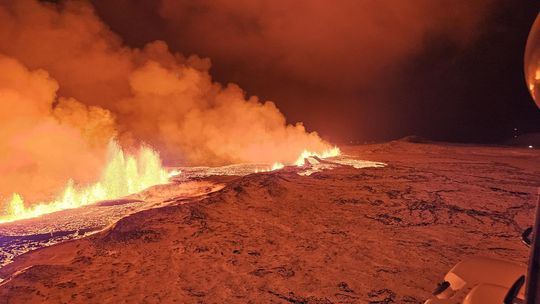
Volcanic activity on 18 December 2023 at the southern end of the fissure at Sundhnúksgíga, Iceland. Source: Icelandic Met Office.
Over the past millennium, Iceland has experienced eruptions approximately every 3 to 4 years on average. Recent eruptions show no evidence of tsunami occurrences. However, there are historically tsunami records possibly resulting from massive volcanic eruptions in 1362 CE and 1721 CE. The event of 1362 was triggered by an explosive eruption, while the one of 1721 was a subglacial eruption that led to an outburst flood. Mr Halldór Björnsson underlined that “the current situation is nothing like those past cases, and it is likely not going to cause a tsunami”.
Addressing the potential for a volcano-generated tsunami, Ms Angela Hibbert from the National Oceanography Centre (NOC, United Kingdom), added that “an eruption can result in phreatic explosions as a result of lava and water interactions, however, the waves produced would likely be small.” The Emergency Response Coordination Centre (ERCC) of the European Commission is also closely following the situation with support of the “All Risk Integrated System TOwards Trans-boundary hoListic Early-warning (ARISTOTLE) Pilot Project”.
For more information on the evolution of the volcanic activity in the Svartsengi system and Sundhnúksgíga, Iceland, please visit the following link.