Sea Level Monitoring
TSU/MAB Coastal Hazards Project
Workshop on Standard Operating Procedures for Tsunami Warning and Emergency Response for Northern and Western Indian Ocean Countries
A regional training workshop on tsunami warning and emergency response Standard Operating Procedures for Northern and Western Indian Ocean countries was held in Hyderabad, India, 23-26 June 2014, hosted by the Government of India through the Indian Centre for Ocean Information Services (INCOIS). The workshop was attended by 30 participants from 11 countries, namely: Comoros, India, Islamic Republic of Iran, Kenya, Madagascar, Maldives, Mauritius, Mozambique, Seychelles, Tanzania and Yemen. The workshop was conducted by a team of 10 trainers from Australia, India, Indonesia, United States, the Asia-Pacific Broadcasting Union, UNESCO Disaster Risk Reduction and Tsunami Information Unit, Jakarta and IOC UNESCO.

The participants represented National Tsunami Warning Centres (NTWCs), Disaster Management Organisations (DMOs) and national media organisations. The workshop programme included lecture sessions, breakout group work, and a site visit to the Indian National Tsunami Warning Centre and IOTWS Regional Tsunami Service Provider at INCOIS. The lectures and training material were based on manuals and templates developed by IOC UNESCO in collaboration with the NOAA International Tsunami Information Centre (ITIC) since 2008.
The primary objectives of the workshop were: to understand RTSP services and products; to understand the impact of the RTSP products on NTWC SOPs; to identify potential gaps and possible challenges for warning chain SOPs at the national level; to familiarise the electronic media with the RTSP service and develop/adapt SOPs for interfacing with the media; and to prepare for the IOWave14 Exercise, scheduled to take place on 9 and 10 September 2014.
The tabletop exercise on the last day of the workshop provided the participants with an opportunity to put into practice what they had learned. The exercise evaluation took the form of a simulated press conference, with NTWC and DMO representatives facing questions from the media and exercise observers.
The workshop was followed on 27th June by intersessional meetings of the IOTWS Working Group 2 on Tsunami Detection, Warning and Dissemination, Working Group 3 on Tsunami Awareness and Response and the Task Team for the IOWave14 Exercise.
Funding to support the participants' travel and subsistence was provided from IOC Special Account funds contributed by the Government of Australia, with funding for local hosting support provided by the Government of India.
Development and Strengthening of Tsunami Exercise Policies in Bangladesh, Myanmar and Timor Leste
The IOC UNESCO project on “Enhancing Tsunami Risk Assessment and Management, Strengthening Policy Support and Developing Guidelines for Tsunami Exercises in Indian Ocean Countries” is being jointly implemented by the Intergovernmental Coordination Group for the Indian Ocean Tsunami Warning and Mitigation System (ICG/IOTWS) and the Indian Ocean Tsunami Information Centre (IOTIC). The project aims to support the development and strengthening of tsunami exercise policies in the three pilot countries of Bangladesh, Myanmar and Timor Leste. The project is supported through a grant from the United Nations Economic and Social Commission for Asia Pacific (UNESCAP) Trust Fund for Tsunami, Disaster and Climate Preparedness.
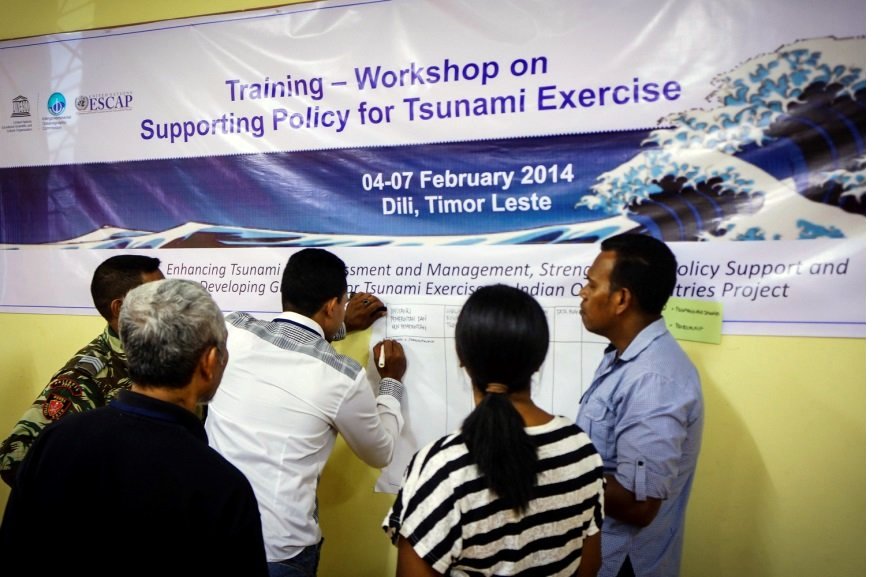
In each pilot country, a stock taking survey designed to assess disaster risk reduction policies relating to tsunami has been undertaken. The survey addresses tsunami risk, hazard, exercise activities and emergency response standard operating procedures via consultation with two main stakeholders in each country.
Training modules on Policy Support and Guidelines for Tsunami Exercises were developed by an expert team comprised of researchers, scientists, government representatives and Disaster Risk Reduction specialists from Indonesia, Malaysia, Pakistan, Sri Lanka and New Zealand. Based on IOC Manuals and Guides Series No. 52: “Tsunami Risk Assessment and Mitigation for the Indian Ocean”, and No. 58: “How to Plan, Conduct and Evaluate Tsunami Exercises”, two training modules were developed, which will be implemented in two separate workshops in three pilot countries. The first training module focuses on the development of national policies to support a sustainable tsunami exercise programme. The second module focuses on how to plan and implement tsunami exercises. The training workshops will assist the three target countries to prepare and actively participate in the upcoming Indian Ocean Wave Exercise scheduled to take place in September 2014. Workshops on the first training module have been undertaken in Dhaka, Bangladesh in November 2013 and in Dili, Timor Leste in February 2014.
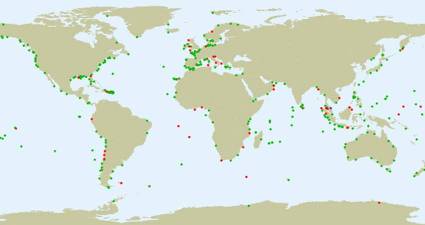
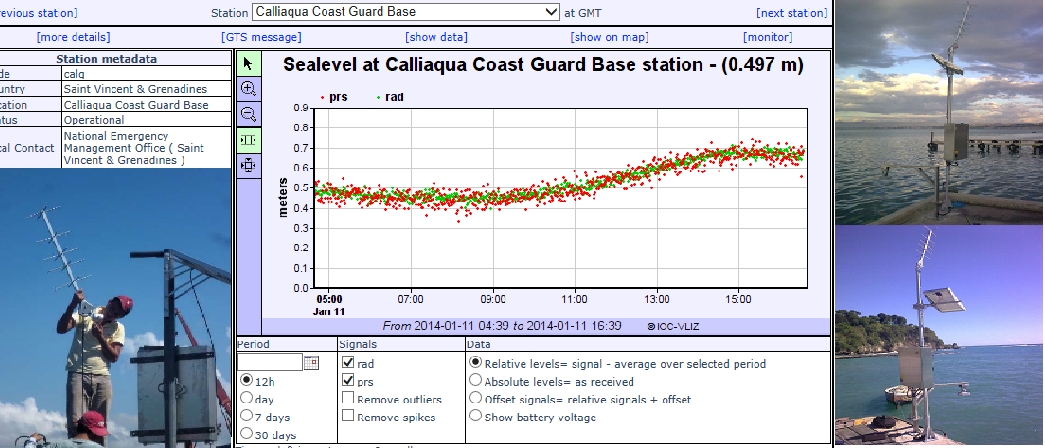
Brazil, Monaco, the European Union and St Vincent & the Grenadines contribute to strengthening the sea level observation network to monitor tsunamis and other coastal hazards in the Caribbean.
In the past 500 years, more than 75 tsunamis have been documented in the Caribbean and adjacent regions. Since 1842, 3446 people are reported to have perished to these killer waves. The tsunami generated by the 2010 Haiti earthquake claimed several lives, but the most recent devastating events were the 1946 tsunamis of the Dominican Republic, with at least 1800 victims.
The most destructive known events have occurred in: 1692 in Port Royal, Jamaica; 1770 in Port-au-Prince, Haiti; 1842 in Port-de-Paix and Cap Haitian; 1867 in Charlotte Amalie, US Virgin Islands; 1882 in San Blas Islands, Panama; 1918 in US Puerto Rico and 1946 in Matanzas, Dominican Republic.
Since then, there has been an explosive increase in residents, visitors, infrastructure, and economic activity along Caribbean coastlines, increasing the potential for human and economic loss.
For tsunami-prone areas, UNESCO's tsunami coordination experience in the Pacific has shown that a proper network of sea level measurement stations do help to provide timely and accurate Early Warnings. With this in mind, the Intergovernmental Oceanographic Commission (IOC) of UNESCO (IOC-UNESCO) commissioned six (6) brand new sea level stations, for Haiti (2), Cayman Islands, Guatemala,St Vincent & The Grenadines and St Kits & Nevis. The stations were installed with the support of Brazil, the European Union, Monaco and St Vincent & The Grenadines; they are now up and running and delivering data through the IOC Sea Level Monitoring Facility
IOC-UNESCO is committed to continue developing end-to-end coastal hazard early warning systems, to save lives and increase tsunami preparedness and readiness in the Caribbean.
Tsunami Standard Operating Procedures (SOP) training in the Caribbean
The International Tsunami Information Center (ITIC), in collaboration with the Caribbean![BG Elton Lewis, Director Virgin Islands Territorial Emergency Management Agency [right] receiving his certificate of completion from Ms. Alison Brome (Interim CTIC Director)](images/BG%20Elton%20Lewis%20Director%20Virgin%20Islands%20Territorial%20Emergency%20Management%20Agency%20right%20receiving%20his%20certificate%20of%20completion%20from%20Ms.%20Alison%20Brome%20Interim%20CTIC%20Director.jpg "BG Elton Lewis, Director Virgin Islands Territorial Emergency Management Agency [right] receiving his certificate of completion from Ms. Alison Brome (Interim CTIC Director)") Tsunami Information Center (CTIC) and the Caribbean Tsunami Warning Program (CTWP) of the United States, with the support of UNESCO's Intergovernmental Oceanographic Commission and the United Nations Development Programme (UNDP) Office for Barbados and the OECS through the Enhancing Resilience to Reduce Vulnerability in the Caribbean (ERC) Project recently hosted a workshop on Strengthening Standard Operating Procedures for Tsunami Warning and Emergency Response, on 4 – 8 November 2013.
Tsunami Information Center (CTIC) and the Caribbean Tsunami Warning Program (CTWP) of the United States, with the support of UNESCO's Intergovernmental Oceanographic Commission and the United Nations Development Programme (UNDP) Office for Barbados and the OECS through the Enhancing Resilience to Reduce Vulnerability in the Caribbean (ERC) Project recently hosted a workshop on Strengthening Standard Operating Procedures for Tsunami Warning and Emergency Response, on 4 – 8 November 2013.
This training workshop is the first substantive activity after the recent establishment of the CTIC and targeted Tsunami Warning Focal Points (TWFPs) and Tsunami Emergency Response (TER) organisations in ten (10) countries in the Caribbean and adjacent region. The 1-week training workshop covered essential topics involved in the end-to-end tsunami warning including event monitoring and detection, threat evaluation and warning, alert dissemination, emergency response, evacuation, and public action. Training also emphasizes the development of sound tsunami warning and emergency response standard operating procedures (SOPs) as a key requirement for a successful end-to-end tsunami warning.
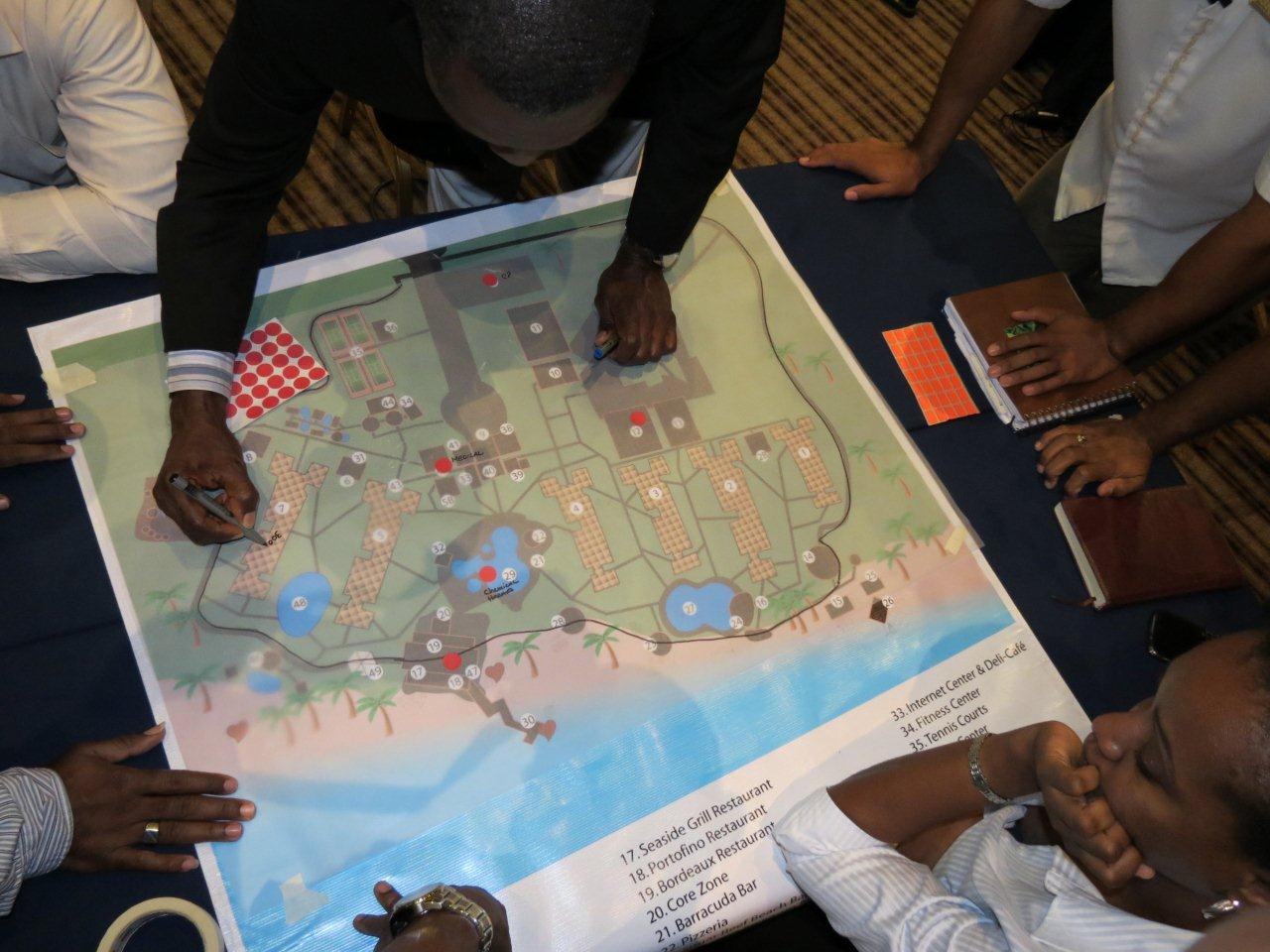
Participants were reminded that an effective tsunami warning system is achieved when all people in vulnerable coastal communities are prepared to respond appropriately and in a timely manner upon recognizing that a potential destructive tsunami may be approaching. Meeting this challenge requires round the-clock monitoring with real-time data streams and rapid alerting, as well as prepared communities, a strong emergency management system, and close and effective cooperation between all stakeholders.
![Mr. Keithley Meade Director Meteorological Office of Antigua and Barbuda [right] receiving his certificate of completion from Dr. Laura Kong (ITIC)](images/Mr.%20Keithley%20Meade%20Director%20Meteorological%20Office%20of%20Antigua%20and%20Barbuda%20right%20receiving%20his%20certificate%20of%20completion%20from%20Dr.%20Laura%20Kong%20ITIC.jpg "Mr. Keithley Meade Director Meteorological Office of Antigua and Barbuda [right] receiving his certificate of completion from Dr. Laura Kong (ITIC)")
This training workshop will be replicated in Barbados during the week 18 – 22 November 2013 catering to the TWFP and TER in the southern Caribbean, for 10 more countries. All together these trainings will get trained around 100 Caribbean officers to prepare for and deal with tsunami emergencies.
More information available from : Bernardo Aliaga, SC/IOC, Этот адрес электронной почты защищен от спам-ботов. У вас должен быть включен JavaScript для просмотра.
Collection of Eyewitness Interviews and Historical Documents on the 1945 Makran Tsunami
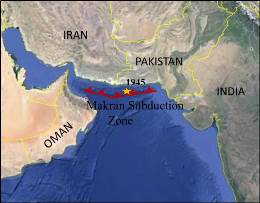 A meeting of the IOC UNESCO project on “Communicating the effects of the 1945 Makran tsunami to increase awareness and preparedness of tsunami hazards in the Makran region” was held in Muscat, Oman from 20-24 October 2013. The meeting reviewed the collection of eyewitness interviews and historical documents on the tsunami that have been obtained during missions to Oman, Pakistan, Iran and India, and formulated plans for further work. The highest priorities for the new activities are 1) interviews in the Indus Delta near Karachi in Pakistan where it appears the majority of fatalities took place and 2) follow-up interviews in Pasni, Pakistan to constrain the timing of the old port sliding into the sea and to explore whether this slide could account for the late, large “second” wave. The collection of eyewitness interviews and historical documents as well as summary material for coastal communities and policy makers will be made available on the Indian Ocean Tsunami Information Center website (iotic.ioc-unesco.org) in 2014.
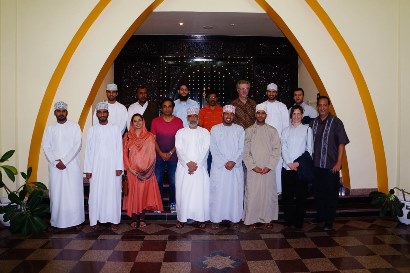 Funding for the project is provided by the ESCAP administered Trust Fund on Tsunami, Disaster and Climate Preparedness in the Indian Ocean and Southeast Asian Countries. The Directorate General of Meteorology and Air Navigation (DGMAN) hosted the meeting. Participants included seven tsunami researchers from the Makran countries, a researcher from the United States, six observers from the Oman Forecasting Centre at DGMAN and three representatives from the IOC UNESCO Secretariat.
Regional Workshop on Standard Operating Procedures for Tsunami Warning and Emergency Response for Northern and Eastern Indian Ocean Countries
A regional training workshop on tsunami warning and emergency response SOPs for Northern and Eastern Indian Ocean countries was held at the Mercure Hotel in Jakarta, Indonesia, 23-27 September 2013, hosted by the Indonesian Agency for Meteorology, Climatology and Geophysics (BMKG). The workshop was attended by 32 participants from 9 countries: Bangladesh, Indonesia, Malaysia, Myanmar, Oman, Pakistan, Sri Lanka, Thailand and Timor Leste. The workshop was conducted by a team of 12 trainers from Australia, India, Indonesia, United States, the Asia-Pacific Broadcasting Union and IOC UNESCO.
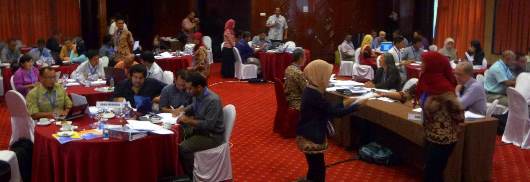
The participants represented National Tsunami Warning Centres (NTWCs), Disaster Management Organisations (DMOs) and national media organisations. The workshop programme included plenary lecture sessions, breakout group work, and site visits to the BMKG tsunami warning centre, the National Disaster Management Centre (BNPB) and a national media organisation (Metro TV).
The primary objectives of the workshop were: to understand RTSP services and products; to understand the impact of the RTSP products on NTWC SOPs; to identify potential gaps and possible challenges for warning chain SOPs at the national level; to familiarise the electronic media with the RTSP service and develop/adapt SOPs for interfacing with the media; and to prepare for the IOWave14 Exercise, scheduled to take place in late 2014.
The tabletop exercise on the last day of the workshop provided the participants with an opportunity to put into practice what they had learned. The NTWC groups reported that they found it difficult to respond to requests for information during the first 30 minutes of the exercise. On the other hand, the DMOs commented that they wanted more information, more quickly from the NTWCs. The media groups commented that they wanted to receive more information faster and preferably at the same time or before sources of unofficial information.
The inclusion of national media organisations in this workshop was particularly enlightening as it exposed several potential gaps in the flow of information between the media and other stakeholders. This highlighted the need for the media to develop SOPs that are harmonised and coherent with the SOPs of other national organisations in the warning chain.
Funding for the workshop was provided from IOC Special Account funds contributed by the Government of Australia. It is planned to conduct a similar workshop for Western and Northern Indian Ocean countries in Hyderabad, India, in 2014.
Еще статьи...
Подкатегории
-
Latest News
- Кол-во материалов:
- 83
-
Newsletter
- Кол-во материалов:
- 5
-
On focus
- Кол-во материалов:
- 5
-
IOTWS News
- Кол-во материалов:
- 1