Sea Level Monitoring
TSU/MAB Coastal Hazards Project
Going “Tsunami Ready” in the Indian Ocean: a UNESCO Online Lecture Series
UNESCO launched an Online Lecture Series to highlight how its Tsunami Ready Program is motivating and encouraging communities in the Indian Ocean to reduce to a minimum the risks from future tsunamis on lives and property.
The six-part lecture series targets community leaders, disaster management offices, NGOs and citizens at large to inform about the Tsunami Ready Program and encourage them to implement the program’s risk reduction protocols and indicators to be recognized as Tsunami Ready by UNESCO’s Intergovernmental Oceanographic Commission (IOC).
Entitled “Interactive Expert Sessions on Piloting IOC-UNESCO Tsunami Ready in the Indian Ocean”, the lecture series is organized by the Indian Ocean Tsunami Information Centre (IOTIC) of UNESCO’s IOC, based in UNESCO’s Jakarta Office, and Indonesia’s Agency for Meteorology, Climatology and Geophysics (BMKG).
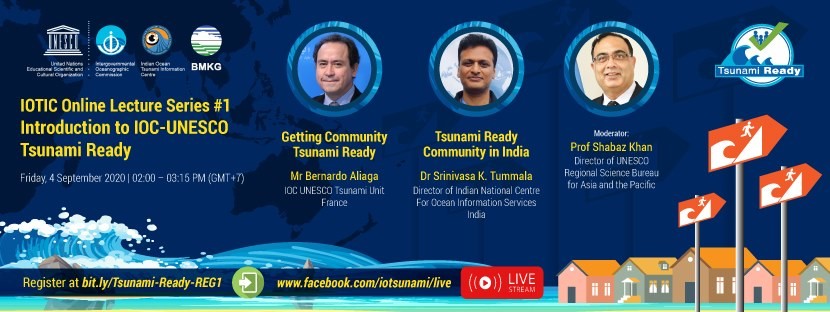
More than simple webinars, the lecture series invites all participants to take part in high level discussion between community members, international experts, and UNESCO representatives about the opportunities and challenges of making vulnerable communities in the Indian Ocean “Tsunami Ready”, in line with international standards set by the UNESCO program. Certificates of completion are awarded for participation on all six sessions.
Throughout six sessions, the lecture series actively calls for more Indian Ocean communities to implement the 12 tsunami preparedness indicators elaborated by UNESCO’s IOC, and to apply for the “Tsunami Ready” recognition. To showcase how this has been successfully done, Invited experts from the region will highlight each of the IOC-UNESCO Tsunami Ready indicators, and share practical experience and examples of communities who have received the IOCUNESCO Tsunami Ready Recognition.
For further information, please contact:
Ardito M Kodijat, Head of the Indian Ocean Information Center (IOTIC)
Cette adresse e-mail est protégée contre les robots spammeurs. Vous devez activer le JavaScript pour la visualiser. or Cette adresse e-mail est protégée contre les robots spammeurs. Vous devez activer le JavaScript pour la visualiser.
Quick links to all sessions:
Lecture Session 1 (4 September 2020): See full recording on Facebook
Lecture Session 2 (11 September 2020): See full recording on Facebook
Lecture Session 3 (18 September 2020): See full recording on Facebook
Lecture Session 4 (25 September 2020): http://bit.ly/Tsunami-Ready-REG4
Lecture Session 5 (2 October 2020): http://bit.ly/Tsunami-Ready-REG5
Lecture Session 6 (9 October 2020): http://bit.ly/Tsunami-Ready-REG6
Lecture Series Highlights
The inaugural first lecture was attended by 382 participants from 33 countries, 18 of which from the Indian Ocean region, with individual participants coming from Disaster Risk Management Offices, National Tsunami Warning Centres, Universities, Non-governmental organization, among other institutions. The session was moderated by Prof. Shahbaz Khan, Director and Representatives of UNESCO Office Jakarta, and had two key lectures: Bernardo Aliaga, Head of Tsunami Unit of IOC UNESCO and Srinivasa Kumar Tummala, Director of Indian National Centre for Ocean Information Services (India).
Mr. Aliaga introduced the IOC Tsunami Ready program aims to encourage and recognize community-based tsunami preparedness, explaining how the program is built on 12 indicators drawn from global best practices in tsunami preparedness, which measure the capacity of a community to respond to a tsunami under three key areas: Mitigation, Preparedness, and Response. The Safer Ocean objective of the upcoming UN Decade of Ocean Science for Sustainable Development 2021-2030 (referred to as “the Ocean Decade”) will also act as a catalyst to significantly increase the number of Tsunami Ready Communities worldwide.
Going into the regional perspective, Prof. Khan and Dr. Tummala discussed about how the Tsunami Ready program has been successfully piloted in India’s coastal provinces. India took this as an opportunity to strengthen the coastal communities’ knowledge and capacity on tsunami preparedness with strong involvement of every level of the Disaster Management Offices (DMO), at the national level such as Ministry of Earth Sciences, Ministry of Home Affairs, NDMA, and Province level DMOs of Odisha, then District, Block and Village level DMOs. Ultimately, however, the success rests with communities’ enthusiastic implementation and continuous volunteer work.
At its vital core, the Tsunami Ready program by UNESCO’s IOC mends the bridge between scientific organizations, technical organizations, disaster management office, and communities that are more often than not very enthusiastic about having the opportunity to contribute to their own resilience vis-à-vis the destructive menace of tsunamis.