Sea Level Monitoring
TSU/MAB Coastal Hazards Project
Exercise Indian Ocean Wave 2023 Strengthens Tsunami Preparedness
The ocean-wide tsunami exercise Indian Ocean Wave 2023 (IOWave23) was conducted during 4-25 October 2023. The exercise consisted of three tsunami scenarios generated by earthquakes in the Andaman, Makran, and Java trenches, and one further scenario of a tsunami generated by a volcanic eruption on Heard Island in the Southern Ocean. All 25 active Member States of the UNESCO Intergovernmental Oceanographic Commission (IOC) Intergovernmental Coordination Group for the Indian Ocean Tsunami Warning and Mitigation System (ICG/IOTWMS) were separately placed under tsunami threat during one or more scenarios.
At least 19 ICG/IOTWMS Member States including Australia, Bangladesh, France (Indian Ocean Territories), India, Indonesia, Iran, Madagascar, Maldives, Mauritius, Myanmar, Oman, Pakistan, Seychelles, Singapore, South Africa, Sri Lanka, Tanzania, Thailand, and United Arab Emirates participated in one or more scenarios. Countries activated their national tsunami warning chains and Standard Operating Procedures with the participation of National Tsunami Warning Centres (NTWCs), Disaster Management Organisations (DMOs), other relevant authorities, first responders, and media.
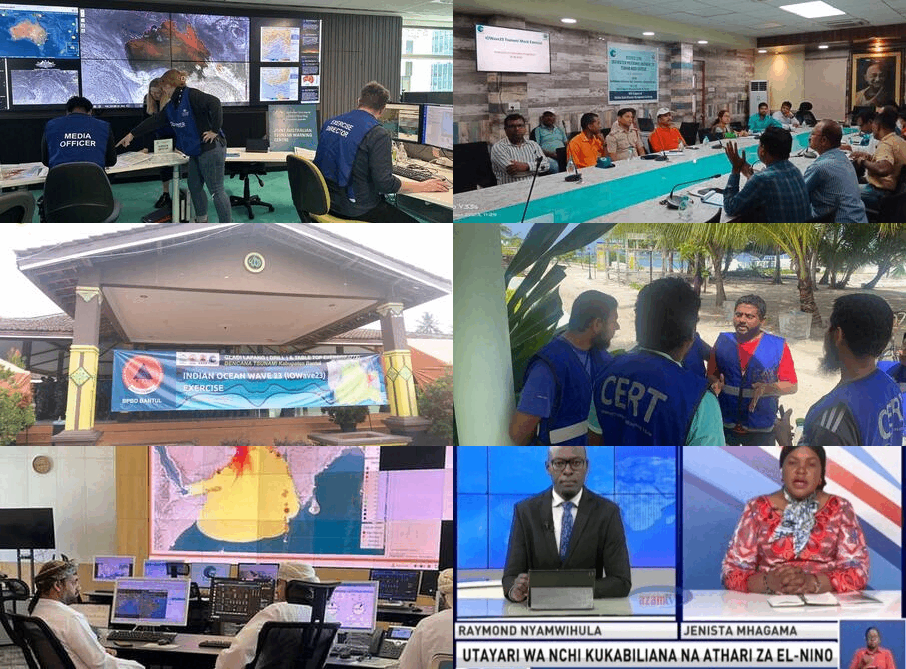
Community evacuation drills were conducted in at least seven countries, including India, Indonesia, Iran, Maldives, Mauritius, Sri Lanka, and United Arab Emirates. The exercise focused on inclusivity (all genders, those with disabilities, youth, and elderly) connected with the central theme of World Tsunami Awareness Day 2023 of “Fighting Inequality for a Resilient Future”.
In India, over 40,000 people were evacuated to shelters/safe places during the Andaman trench scenario. Around 42 coastal villages from 12 districts of 4 coastal States / Union Territories of Odisha (32 villages), Andaman (3), Puducherry (4) and Tamil Nadu (3) were involved during the exercise on 4 October 2023. Community members, school students, and the elderly were involved in the evacuations.
In Indonesia, 11 coastal provinces participated in the Java trench scenario on 25 October. Over 1,650 community members participated in the evacuation drills. This included Kelurahan Serangan, Bali (136); Pelabuhan Benoa, Bali (48); Pantai Barat Pangandaran, Jawa Barat (100); Pelabuhan Perikanan Cikidang Pangandaran, Jawa Barat (104); Bandara Nusawiru, Jawa Barat (100); Desa Cikakak – Sukabumi, Jawa Barat (40); Pangarangan, Banten (106); Desa Muara Lebak, Banten (70); Kelurahan Murti Gading, Bantul (320); Kelurahan Glagah, Yogjakarta (200); Pantai Kukup Kemadang, Yogjakarta (50); Desa Sidaurip – Cilacap, Jawa Tengah (110); Desa Sarangon, Jawa Timur (70); Tambakrejo, Jawa Timur (100); and Desa Oesapa – Kupang, Nusa Tenggara Timur (100). An additional 23 communities undertook table-top exercises.
In Iran, about 500 people in Chabahar and Jask undertook community evacuations during the Makran trench scenario. Field sirens and public speakers were activated, and evacuation procedures were put into action. The day prior to the exercise, pre-exercise training workshops were held in both communities to raise tsunami preparedness.
In the Maldives, Baa Kendhoo council made community safety a top priority. Evacuations of community members including vulnerable groups took place during the Java trench scenario. The day prior to the drill, a tsunami information session was held by the National Disaster Management Authority for students, parents, and teachers.
In Mauritius the exercise involved the mainland, Rodrigues Island, and Agalega utilising the Java trench scenario. Evacuations were carried out at Quatres Soeur and Riviere Des Galets where about 100 people including adults, children, elderly, and disabled people moved to higher ground. In Rodrigues, about 200 people were evacuated from Gravier, St Francois, and Pointes Coton. Mostly coastal residents and lodges as well as schools were targeted in Gravier.
In Sri Lanka, nearly 2,000 people participated in community and school evacuations. The communities of Pudawaikkadu Village, Maruthankudah Village, and Sagarapura Village (Trincomalee District) included persons with disabilities, pregnant and lactating mothers, elderly, and children in the drill. The villages tested the UNESCO-IOC Tsunami Ready indicators. The students and staff at three schools participated in the drill. The schools were Nooriya Muslim College in Trincomalee District, Mahamaya Girls College in Matara District, and Madampagama Central College in Galle District.
In the United Arab Emirates, an evacuation exercise was held in Al Righailat area in the Emirate of Fujairah. In total, approximately 500 people participated including residents, visitors, local authorities, and non-governmental organisations. Participation included all community categories: men, women, children, elders, youth, and people with disabilities. The exercise was a valuable opportunity to test the UAE’s tsunami warning and response system and to engage different communities.
During the Heard Island Volcano scenario, the Joint Australia Tsunami Warning Center (an ICG/IOTWMS Tsunami Service Provider) issued its new tsunami threat bulletins for non-earthquake induced tsunamis to all NTWCs around the Indian Ocean for the first time. This marked a significant milestone in the capability to respond to tsunamis resulting from volcanic and other non-seismic events.
Mr Kevin Rae of the South Africa Weather Service remarked, “It was very encouraging to deal with a volcanic source during this exercise, as this represents a more holistic and inclusive approach, by the ICG/IOTWMS, to potential tsunami-generating events within the greater Indian Ocean basin.”
The overall status of national tsunami warnings in the Indian Ocean, as reported by the official authorities within participating countries, were displayed throughout the exercise on Tsunami Service Provider Australia’s public website (www.bom.gov.au/tsunami/iotwms).
National broadcasting media provided coverage in the lead-up to and during the exercise. Social media platforms adopted the #iowave23 hashtag for enhancing public awareness of the exercise. A public outreach website for all IOWave exercises (www.iowave.org) is maintained by the Indian Ocean Tsunami Information Center.
Exercise IOWave23 is the 7th Indian Ocean wide exercise held by UNESCO-IOC, with previous exercises held in 2009, 2011, 2014, 2016, 2018, and 2020. At its 13th Session (Bali, Indonesia, November-December 2022), the Intergovernmental Coordination Group for the IOTWMS decided to organise IOWave23 and established a Task Team with experts from Australia, India, Indonesia, Oman, and Pakistan to plan and manage the exercise.
Indian Ocean nations called for the establishment of an Indian Ocean Tsunami Warning and Mitigation System in the wake of the 2004 tsunami disaster. After an Interim Alert System (IAS) was established in 2005, the new comprehensive system became fully operational in 2011 with the support of UNESCO’s Intergovernmental Oceanographic Commission (IOC).
UNESCO promotes scientific exchange and collaborative efforts to establish effective early warning systems for tsunamis. UNESCO’s IOC assists countries to improve Standard Operating Procedures through stakeholder workshops and evaluations by ocean-wide exercises, as well as overall scientific coordination across regions.