Sea Level Monitoring
TSU/MAB Coastal Hazards Project
Expert Consultation on Scientific Tsunami Hazard Assessment of the Makran Subduction Zone
The Makran Subduction Zone (MSZ) is still poorly understood even though it poses a major tsunami risk in the North West Indian Ocean. Several decades after the 1945 tsunami that caused hundreds of confirmed fatalities, there are still open questions about whether the MSZ is able to generate such large tsunamis in the future. There are also questions about tsunami triggering mechanisms in the Makran, with tectonic deformation and submarine landslides being viewed as probable sources. In the worst case, tsunami waves generated by a Makran source would reach adjoining shores within a few tens of minutes with height of several metres, posing enormous challenges to tsunami warning systems, as witnessed from the recent Palu and Sunda Strait tsunamis in Indonesia.
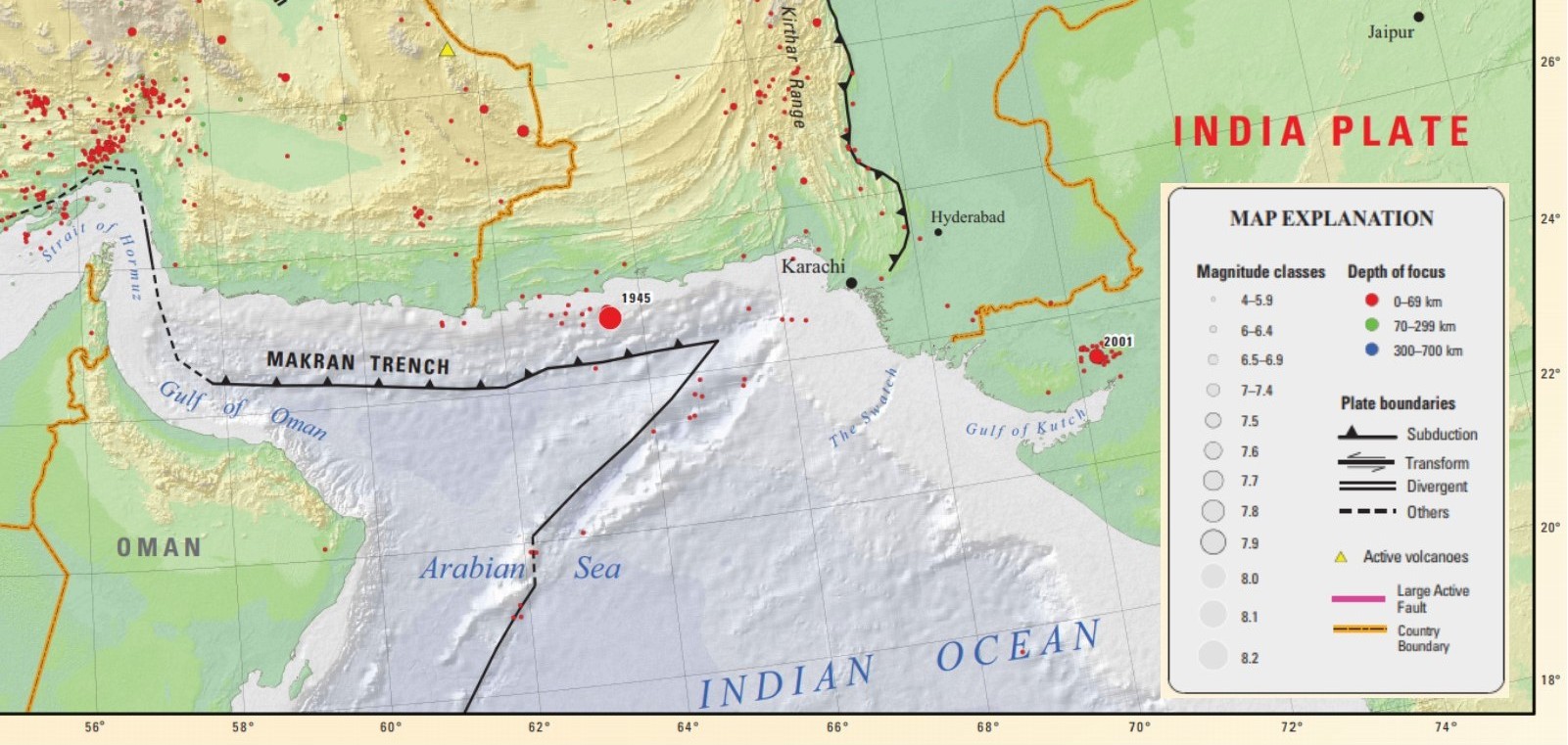
Figure: The Makran subduction zone is an active boundary between the converging Arabian and Eurasian plates. The trench extends for about 800km and dips gently northward beneath the Arabian Sea coasts of Iran and Pakistan. Credit: Seismicity of the Earth 1900–2010. U.S. Geological Survey, 2014.
With this background, IOC-UNESCO organised an Expert Consultation on Scientific Tsunami Hazard Assessment for the Makran Subduction Zone on 8 March 2019 in Kish Island, Iran, immediately prior to the 12th Session of the Intergovernmental Coordination Group for the Indian Ocean Tsunami Warning and Mitigation System (ICG/IOTWMS-XII). The Expert Consultation was attended by 59 experts from 11 countries (mainly Australia, India, Indonesia, Iran, Oman, Pakistan, Portugal, Russian Federation, Switzerland, Thailand, USA), 1 UN agency (APDIM), research institutions, universities, private organisations and 3 Secretariat staff.
The Expert Consultation was successful in identifying current status, gaps and future priorities in the MSZ with reference to (i) Optimal observing networks for effective tsunami warning in the MSZ, (ii) Seismicity of the MSZ and Credible Maximum Earthquake Magnitude, (iii) Tsunami Hazard Assessment in the MSZ, (iv) Potential impact of Seismic and Secondary non-seismic effects on tsunami generation in MSZ including Red Sea and Persian Gulf and (v) Last-mile. Findings of the Expert Consultation were reported to the ICG/IOTWMS-XII session, that recommended establishing two Task Teams on “Tsunami Preparedness for a near-field Tsunami Hazard” and “Scientific Tsunami Hazard Assessment of the Makran Subduction Zone”, whose activities will be closely aligned to an upcoming project on “Strengthening Tsunami Early Warning in the North West Indian Ocean” being funded though the ESCAP multi-donor trust fund for tsunami, disaster and climate preparedness. Planned activities will enhance collective understanding of the Makran tsunami hazard, and assist Member States to assess their tsunami risk, strengthen national warning systems, enhance warning chains, develop evacuation plans, build emergency response capacity and raise community awareness, preparedness and resilience with specific emphasis on a near-field tsunami threat.
Meeting documents and presentations are available at www.ioc-tsunami.org/msz_expert_consultation.