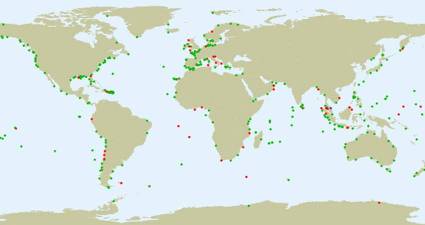
Sea Level Monitoring
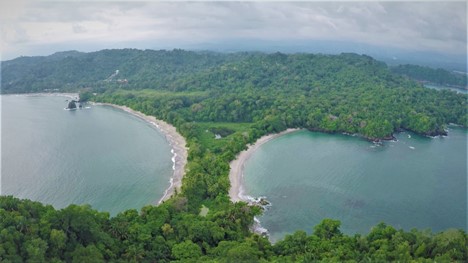
TSU/MAB Coastal Hazards Project
Strengthening Ecuador’s preparedness to tsunamis
Located above the plate boundary where the Nazca Plate is subducting beneath the South American Plate, Northern Ecuador and Southern Colombia are at high risk of earthquakes and tsunamis.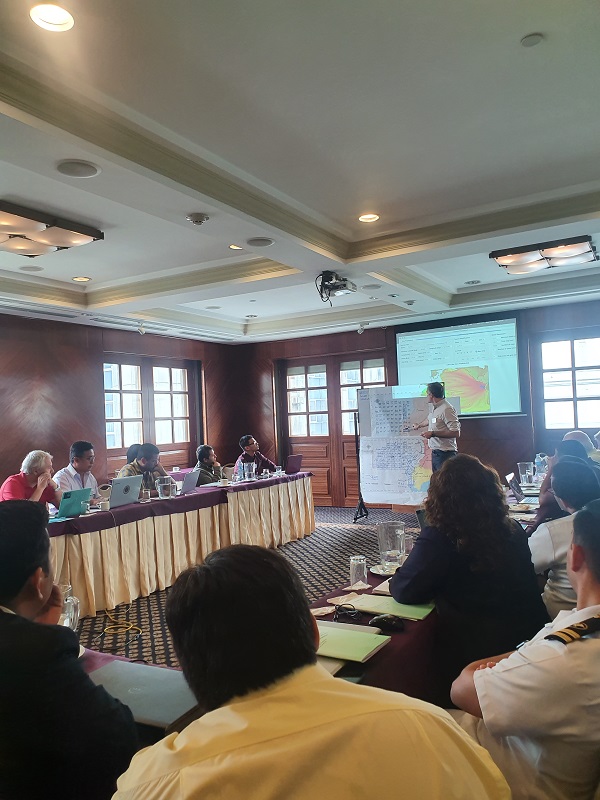
During the course of the last century, two major earthquakes that triggered destructive tsunamis hit the two countries: the 1906 Ecuador-Colombia earthquake (Mw 8.8 of magnitude) and the 1979 Tumaco earthquake (Mw 8.2 of magnitude). More recently, on 16 April 16 2016 a Mw 7.8 earthquake hit again the coast of Ecuador, killing more than 600 people. A tsunami alert was issued by the NOAA Pacific Tsunami Warning Center for Colombia, Costa Rica, Ecuador, Fiji, Panama and Peru.
Tsunami early warning is critical to protecting lives in the aftermath of an earthquake. To strengthen national preparedness to the risk of tsunami, the Government of Ecuador and UNESCO’s Intergovernmental Oceanographic Commission – which have a long-standing technical cooperation in place in this area – organized an Expert Meeting on 27-29 January in Guayaquil, on the Ecuadorian coast. The Meeting focused on tsunami sources, hazards, risk and associated uncertainties along the Colombia-Ecuador border. Experts in the fields of seismology, geology, geodesy, sea level monitoring, sedimentology, tectonics, tsunami modelling, paleo-seismology and paleo-tsunami were consulted during the meeting in order to develop and explore potential tsunami hazard and credible scenarios for the area. A significant part of the meeting was also dedicated to explore current research projects and potential collaborations. The commitment of all participants allowed for fruitful discussions whereby modelled tsunami inundation scenarios were brainstormed and visualized.
High importance was placed on the engagement of local communities: representatives from the local Gobiernos Autónomos Descentralizados (GAD) were invited to take part into a public awareness event hosted by the Oceanographic Institute of the Ecuadorian Navy (INOCAR) at the Navy Officers’ club in Guayaquil as part of the official programme of the Meeting.
Summary Statement from the International Symposium on Lessons Learnt from the 2018 Tsunamis in Palu and Sunda Strait
Indonesia was hit by two destructive tsunamis in late 2018, which challenged traditional understanding of tsunami hazard, warning and response mechanisms. The first event was the Palu and Donggala tsunami of 28 September 2018, following the 7.5 magnitude earthquake in Central Sulawesi, that killed about 1,252 people. The second was the Sunda Strait tsunami of 22 December 2018, following an eruption and partial flank collapse of the Anak Krakatau volcano, that killed about 437 people.
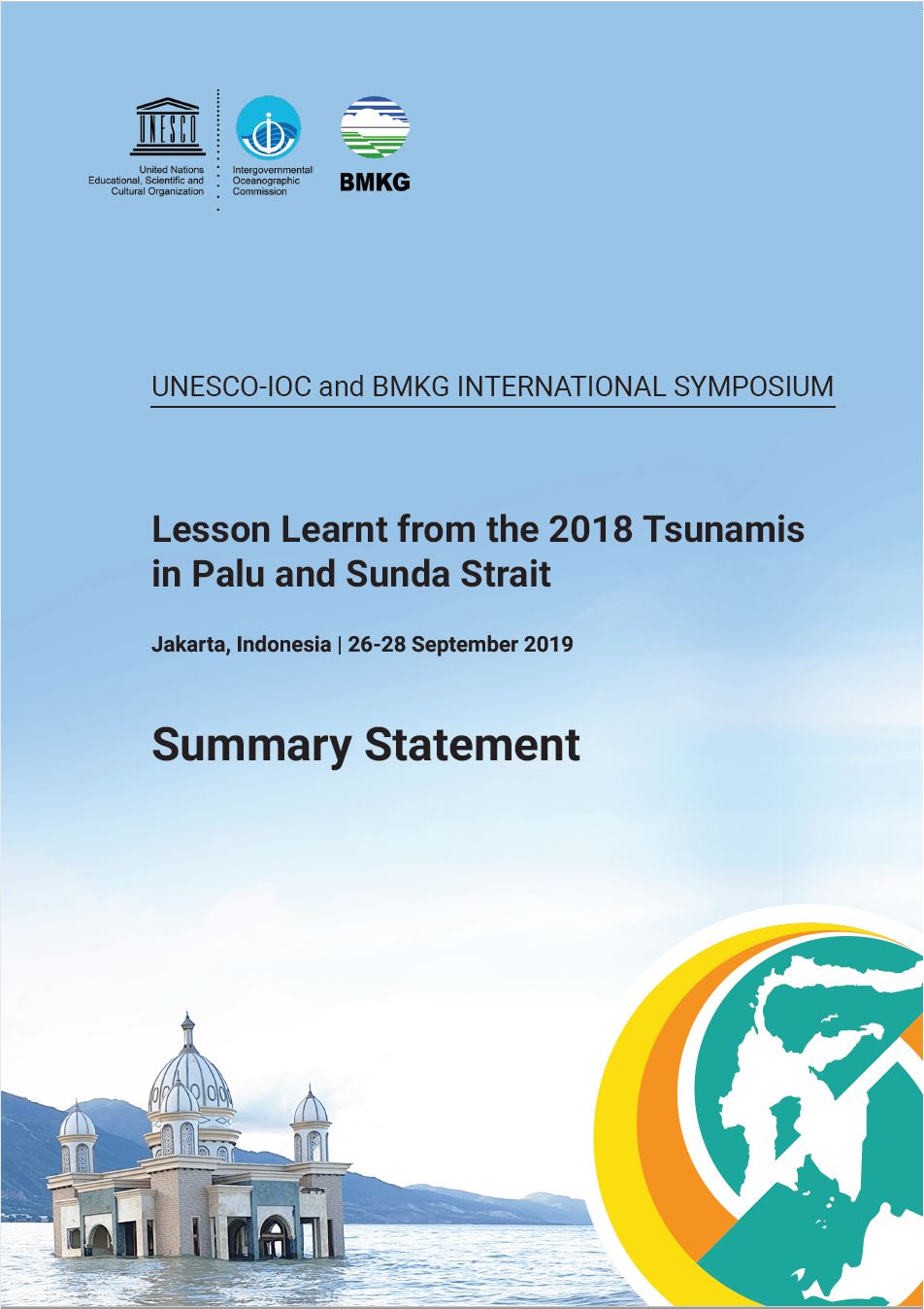 In commemoration of the one year anniversary of the Palu and Donggala tsunami, UNESCO’s Intergovernmental Oceanographic Commission (IOC) in collaboration with the Government of Indonesia through its Coordinating Ministry for Maritime Affairs (CMMA) and Agency for Meteorology, Climatology, and Geophysics (BMKG) organised an International Symposium on ”Lessons Learnt from the 2018 Tsunamis in Palu and Sunda Strait” at BMKG, Jakarta, Indonesia during 26-28 September 2019.
The Symposium highlighted that tsunami warning systems are always faced with the dilemma of time versus uncertainty. It is important to assess the possibilities and limitations of scientific knowledge and technology vis-à-vis the information needs of disaster managers, and make continuous improvements in both technical and social components of tsunami early warning systems.
To view the Summary Statement from the Symposium, please click on the image.
Indian Ocean Tsunami Warning and Mitigation System Factsheet (2019)
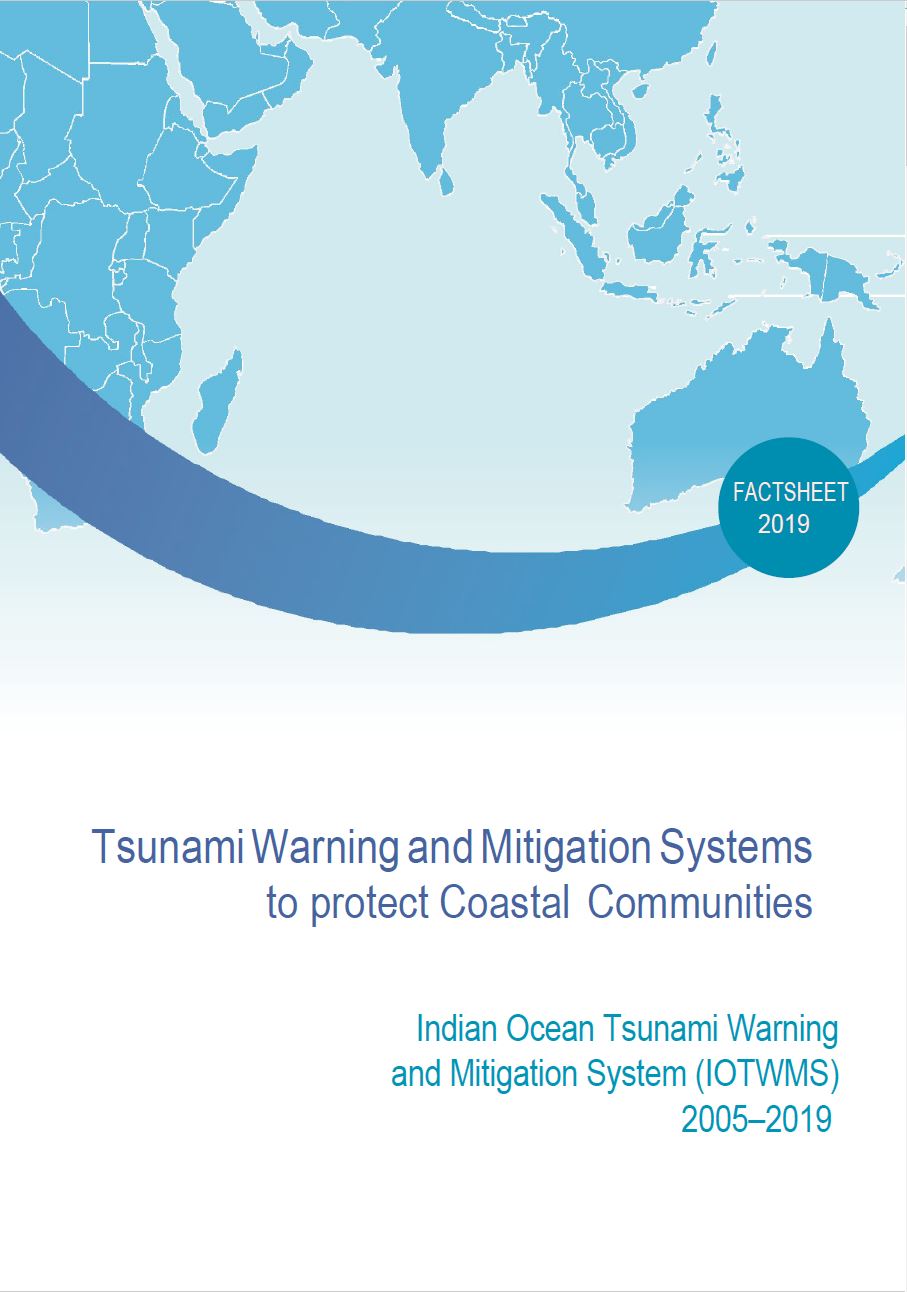
Noting the 15th anniversary of the 2004 Indian Ocean Tsunami, the Intergovernmental Coordination Group for the Indian Ocean Tsunami Warning and Mitigation System (ICG/IOTWMS) has published a new version of its factsheet. This reflects significant advancements in the system since the previous factsheet was released in 2015.
The 2019 IOTWMS factsheet includes information on the terms of reference, membership and governance of the ICG as well as details of the earthquake and sea-level monitoring networks, area of service and earthquake source zones. New additions to the factsheet include the operational websites of the National Tsunami Warning Centres of IOTWMS Member States, details of tsunamis in the Indian Ocean since 2004, and an overview of the UNESCO-IOC Tsunami Ready initiative.
To view the factsheet, please click on the image.
26 December 2019 marks the 15th Anniversary of 2004 Indian Ocean Tsunami
26 December 2019 marks the 15th anniversary of 2004 Indian Ocean Tsunami that killed about 230,000 people in 14 countries in the Indian Ocean region. Commemorating this occasion, UNDRR produced a video highlighting the important elements and contributions of UNESCO-IOC, WMO, UNDP, UNESCAP and UNDRR in strengthening end to end people centred early warning systems. The video can be viewed at: https://youtu.be/J-Q4IZPJLxw
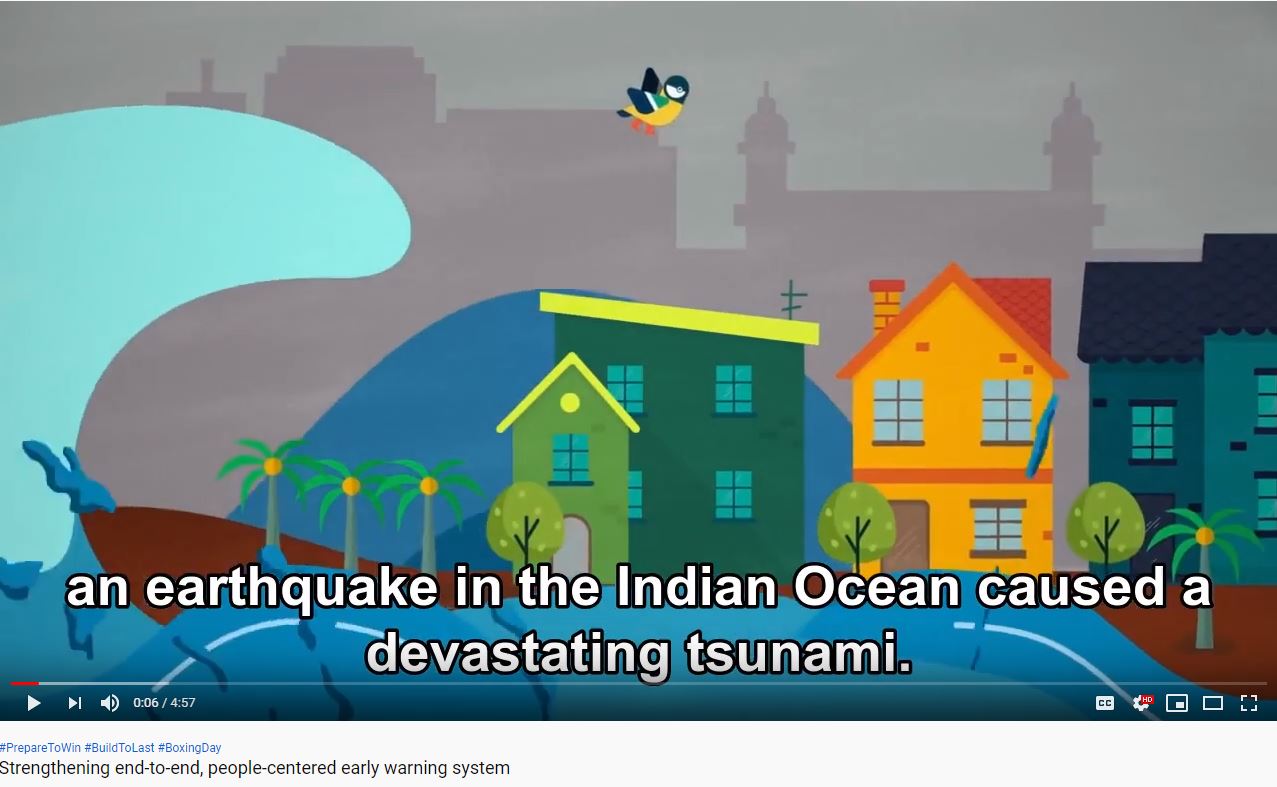
It may be recalled that the 2004 Indian Ocean Tsunami triggered the establishment of IOC-coordinated regional tsunami early warning systems in the Indian Ocean, Caribbean and Northeast Atlantic & Mediterranean, to join a system that was already operational in the Pacific. They operate as a globally integrated "system of systems" built on three pillars - tsunami risk assessment and mitigation; tsunami detection, warning and dissemination; and tsunami awareness and response.
The Indian Ocean Tsunami Warningn and Mitigation System (IOTWMS) is operational since 2013 with Tsunami Service Providers (TSPs) established by Australia, India and Indonesia providing tsunami forecast information to the National Tsunami Warning Centres (NTWCs) of 25 Member States in the Indian Ocean region.
Sixteenth Session of the ICG-NEAMTWS : IPMA, Portugal is the Fifth Tsunami Service Provider the NEAM Region
The Sixteenth Session of the Intergovernmental Coordination Group for the Tsunami Warning and Mitigation System in the North-eastern Atlantic, the Mediterranean and connected seas (ICG/NEAMTWS) was held from 2–4 December 2019, Cannes, France. The session was hosted by the municipality of Cannes.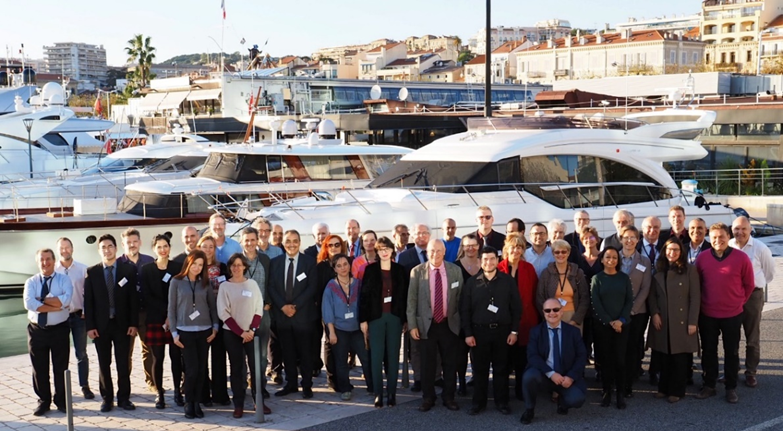
Photo by Jörn Beherens
The Sixteenth Session of the Intergovernmental Coordination Group for the Tsunami Warning and Mitigation System in the North-eastern Atlantic, the Mediterranean and connected seas (ICG/NEAMTWS) was held from 2–4 December 2019, Cannes, France. The session was hosted by the municipality of Cannes.
There is considerable infrastructure build up along the coast of Cannes and a port with many expensive yachts. A total of 3 million people visit Cannes each year, including 320 cruise passengers. The Palais des Festivals et des Congrès de Cannes is located close to the coast and the congress center hosts 50 major events per year including the Cannes Film Festival, and several thousands people attend these events. Cannes has taken several steps to mitigate tsunamis. Cannes has adopted the World Tsunami Awareness Day, 5 November as an annual event since 2017. It has carried out two Tsunami exercises, installed tsunami evacuation signs and adopted a comprehensive risk information document for its inhabitants (that also include a section on Tsunami). Lately, a charter for a set of city employee concerning Tsunami risks and inundation. Many of these efforts represents a first among municipalities in France and Cannes is a beacon or pilot town in that respect.
Participants reviewed the progress made in the implementation of the NEAMTWS.
The session approved accreditation of IPMA (Portugal) as a Tsunami Service Provider (TSP). IPMA is the fifth center to receive accreditation in the NEAM region. Several countries have subscribed to receive tsunami alert messages from IPMA.
The session discussed progress made regarding the formulation of the NEAMTWS Strategy and Implementation Plan and decided on how to complete the plan by next ICG/NEAMTWS. Plans for the further development of the NEAM Tsunami Information Centre (NEAMTIC) were also discussed and should be finalised at next ICG/NEAMTWS session.
The Group recognized the efforts devoted to increasing awareness on tsunami hazards and preparedness in particular in France, Italy, Greece and Turkey in line with and as a contribution to World Tsunami Awareness Day, 5 November 2019.The session also discussed the framework for providing Tsunami alerts to the maritime community which TOWS-WG (Tsunamis and Other Ocean Hazards Warning and Mitigation Systems Working Group) had developed in collaboration with the IHO/IMO World-Wide Navigational Warning Service Sub-Committee (WWNWS-SC). At this time, TSPs in NEAM region indicated the need to learn from the experiences gained in other ICG regions before taking on such a service for the NEAM region.
The session decided to carry out the NEAMWave 20 tsunami exercise on 2-4 November 2020 back-to-back with the World Tsunami Awareness Day, 5 November 2020.
Germany offered to host the seventeenth session of the ICG/NEAMTWS.
The Sixteenth session of ICG/NEAMTWS was attended by around 52 participants from 14 member countries and few observers.
More Articles...
- Indian Ocean Regional Workshop on Strengthening Tsunami Warning Chain to Critical Infrastructure in Jakarta, Indonesia; 20-22 November 2019
- Commemorating the WTAD, 5 November 2019 in NEAM region
- FIJI AT WORLD TSUNAMI AWARENESS DAY 2019
- Grenada receives second Tsunami Ready recognition on World Tsunami Awareness Day
About the Tsunami Programme
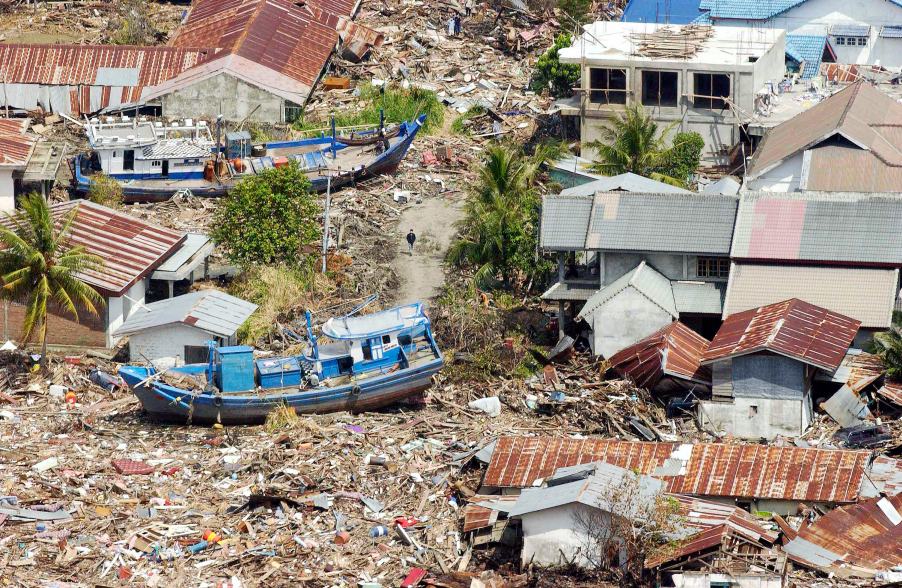
The Indonesian coast, between Banda Aceh and Meulaboh, after the earthquake and the tsunami of 26 December 2004. Photo by Evan Schneider © UN Photo
UNESCO supports Member States in improving capabilities for tsunami risk assessment, implementing early warning systems and enhancing preparedness of communities at risk. UNESCO works closely with national institutions and promotes inter-institutional and regional cooperation. Specialized regional centers provide tsunami information that, together with national analysis, is the basis of the warnings issued for the public. In addition, UNESCO promotes community-based approaches in the development of response plans and awareness campaigns which strongly involve education institutions and end-users.
Upcoming Events
7 August 2024
19 August 2024
19 - 30 August 2024
Chile