Sea Level Monitoring
TSU/MAB Coastal Hazards Project
International Day for Disaster Reduction 2016: Live to Tell
The International Day for Disaster Reduction (IDDR), held every year on the 13th October, celebrates how people and communities around the world are reducing their exposure to disasters and raising awareness about the importance of risk mitigation. UNESCO seeks to bolster the resilience of societies through early warning, capacity building, knowledge sharing and networking, and policy advice through working with governments, civil society, research institutions, other UN agencies and international 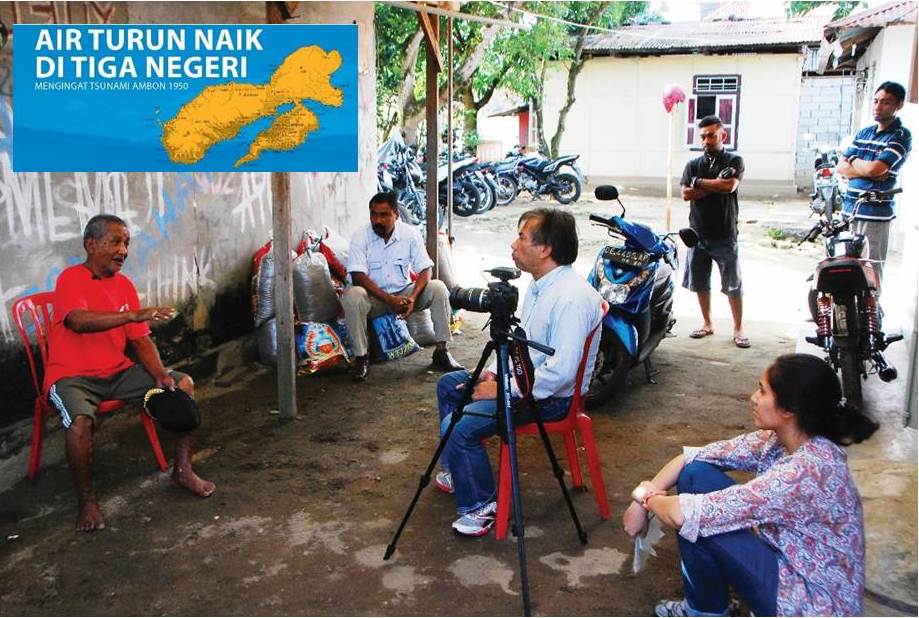 organizations, and all key stakeholders.
The Indian Ocean Tsunami Information Centre (IOTIC) of UNESCO IOC, housed in UNESCO Office Jakarta, published a booklet in Bahasa Indonesia, “Air Turun Naik di Tiga Negeri” (Tsunami in Three Villages), remembering the 1950 Tsunami in Ambon.
The booklet is in line with the theme of the IDDR 2016: "Live to Tell: Raising Awareness, Reducing Mortality", which aims to create a wave of awareness about global actions to stop disasters from claiming lives. The story documents 28 eyewitnesses of a tsunami that happened on a Sunday afternoon on 8 October 1950 in three villages in the island of Ambon, namely, Negeri Hutumuri, Negeri Hative Kecil and Negeri Galala.
There is limited information about the tsunami that happened during the unstable geopolitical situation in the Island of Ambon with the fighting between the Tentara Nasional Indonesia – TNI (Indonesian Army) and the Tentara Republik Maluku Selatan – RMS (Army of the Independent South Moluccas). These eyewitnesses, now aged 70-80, told their experiences of survival during the event. Their stories have raised the awareness of the local government, the community, and the next generation on the tsunami hazards that exist in the island.
The “Air Turun Naik di Tiga Negeri” booklet was officially handed to the local government and the community on Saturday, 8 October 2016 in the Hative Kecil Church during the community mass that is held every year to commemorate the disaster.
The booklet and additional information about the 1950 Ambon tsunami can be downloaded from http://iotic.ioc-unesco.org/.
Thirteenth Session of the Intergovernmental Coordination Group for the Tsunami Early Warning and Mitigation System in the North-eastern Atlantic, the Mediterranean and Connected Seas (ICG/NEAMTWS-XIII): Four Tsunami Service Providers Accredited
The Thirteenth Session of the Intergovernmental Coordination Group for the Tsunami Warning and Mitigation System in the North-eastern Atlantic, the Mediterranean and connected seas (ICG/NEAMTWS) was held from 26–28 September 2016, Bucharest and hosted by the National Institute for Earth Physics of Romania. It marked an important milestone in the development of NEAMTWS. The session will be particularly remembered for the Group’s approval of the accreditation of the four Candidate Tsunami Service Providers of CENtre d'Alerte aux Tsunamis (France), Istituto Nazionale di Geofisica e Vulcanologia - Centro Allerta Terremoti (Italy), National Observatory of Athens (Greece) and Kandilli Observatory and Earthquake Research Institute (Turkey) and that they henceforth can be referred to as Tsunami Service Providers.
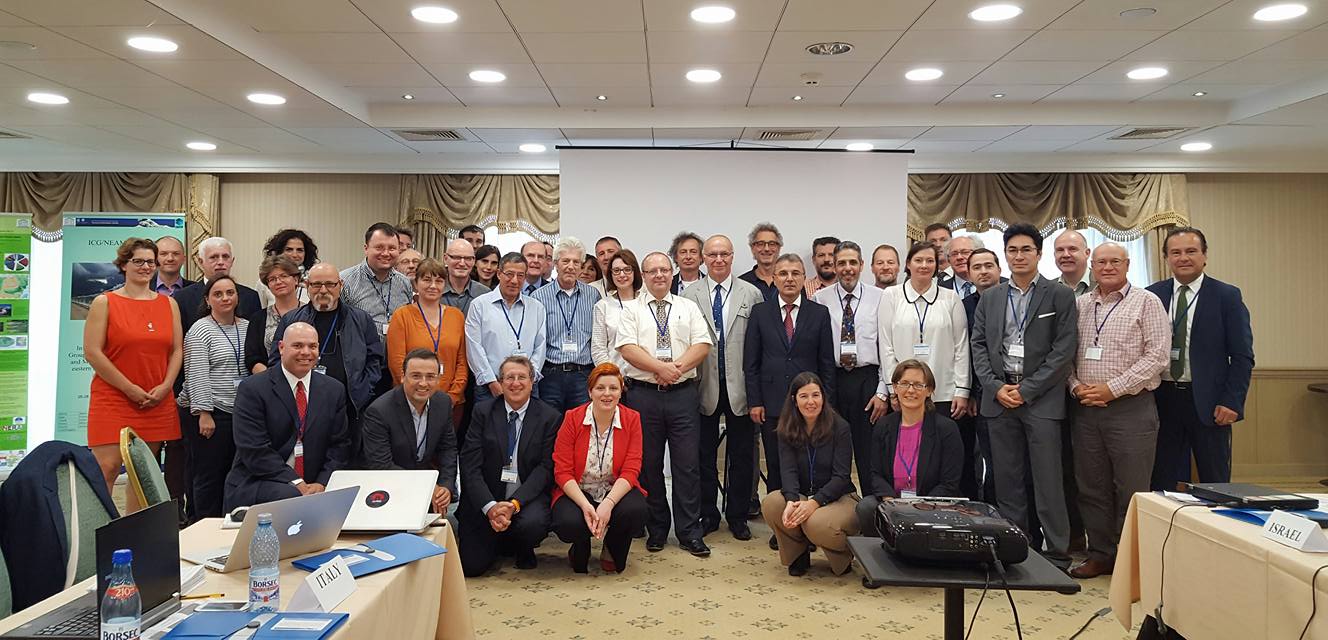
Participants of the ICG /NEAMTWS-XIII, Bucharest, Romania, 26-28 September 2016,
Source: Denis Chang Seng/ IOC-UNESCO
NEAMTWS is one of four regional tsunami warning systems and is the only system where the ICG has decided that Tsunami Service Providers should be accredited. The basic accreditation procedure and criteria were established by ICG/NEAMTWS in 2012 and updated in 2015. Following the formal application to be accredited two accreditation teams reviewed the procedures of the four Candidate Tsunami Service Providers during June –September 2016. The findings of the accreditation teams are available on the meeting web-site.
The Group was informed about the joint institutional effort in monitoring of earthquakes and tsunamis in the western Black Sea area and the intentions of Romania to establish a National Tsunami Warning Center. The Group noted and welcomed the intention of Portugal to start its National Tsunami Warning Center in 2017.
The Group decided to organize a tsunami wave exercise in the 4th quarter of 2017 (NEAMWave17). A Task Team was established to coordinate the exercise.
The Group was also informed about the decision in Israel to put up permanent standard tsunami information and evacuation signs along its entire coast.
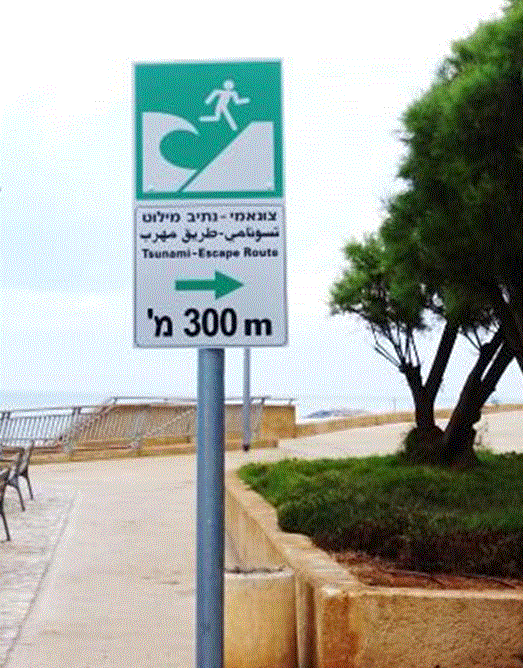
Tsunami information and evacuation signs along the coast in the city of Ashkelon,
Ashdod, Ashdod Sea Port, Israel, Source: Amir Yahav
Amir Yahav
Finally, the Group was informed about UNISDR’s plans for the First World Tsunami Awareness Day (5 November 2016). More information about WTAD is available from http://www.unisdr.org/2016/tsunamiday/ .
The Thirteenth session of ICG/NEAMTWS was attended by 48 participants from 14 member states and two observer organizations.
UNISDR News Article Europe to strengthen tsunami alert system
Indian Ocean Countries Test Tsunami Preparedness down to Community Level during Exercise IOWave16
Twenty-four countries* bordering the Indian Ocean participated in a large scale tsunami simulation exercise organised under the auspices of the Intergovernmental Oceanographic Commission of UNESCO on 7 and 8 September 2016. The exercise, known as Indian Ocean Wave 2016 (IOWave16), tested communication links between all stakeholders of the Indian Ocean Tsunami Warning and Mitigation System (IOTWMS), as the rapid transmission of messages between authorities and populations at risk is crucial to save lives in the event of a tsunami.
The exercise comprised two scenarios: the first simulated an earthquake with a 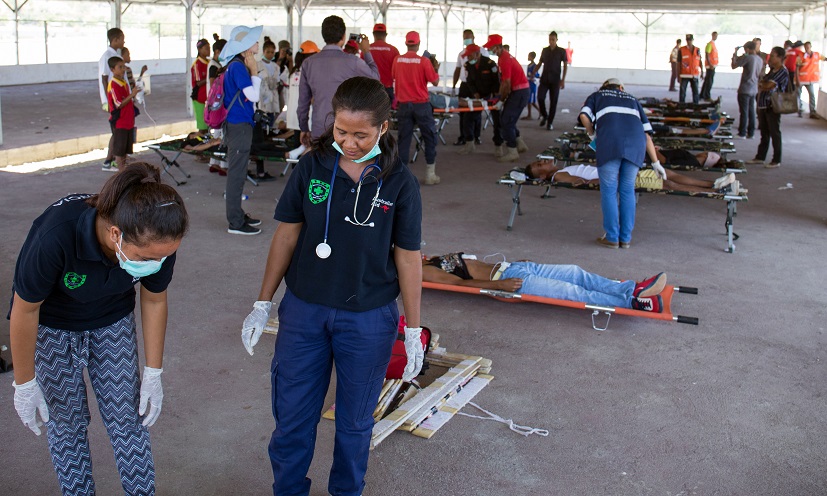 magnitude of 9.2 south of Sumatra, Indonesia, on 7 September; the second simulated an earthquake with a magnitude of 9.0 in the Makran Trench south of Iran and Pakistan on 8 September. Operations began when the Tsunami Service Providers of Australia, India and Indonesia issued alert notifications to the 24 IOTWMS Member States. Simulating tsunami waves travelling across the Indian Ocean, the exercise was conducted in real-time and lasted about 12 hours each day.
Photo: National and international emergency responders practice mock medical aid during Exercise IOWave16 in Tasi Tolu, Dili, Timor-Leste, 7 September 2016 (Eivind Oskarson, UNRCO Timor-Leste).
The exercise included community evacuation drills, involving around 60,000 participants, in Australia, Comoros, India, Indonesia, Iran, Kenya, Mauritius, Oman, Pakistan, Seychelles, Sri Lanka and Timor Leste. In Sri Lanka 14 villages evacuated, involving some 7,000 participants. In Oman eight schools and about 8,000 students took part in simulated evacuations. In India, community level evacuations were carried out in about 350 villages involving 40,000 participants. An evaluation is being conducted to identify gaps and weaknesses in the system and to improve the IOTWMS.
Photographs and videos of Exercise IOWave16 are available at iowave16.org. There was considerable media interest in the exercise, and some 112 news articles and videos have so far been noted. A list of these news links is available for download here.
*Australia, Bangladesh, Comoros, France (Réunion), India, Indonesia, Iran, Kenya, Madagascar, Malaysia, Maldives, Mauritius, Mozambique, Myanmar, Oman, Pakistan, Seychelles, Singapore, South Africa, Sri Lanka, Tanzania, Thailand, Timor-Leste and Yemen.
Madame Irina Bokova met with the Vice Chairman of ICG/IOTWMS in Sri Lanka
Madame Irina Bokova, the Director-General of UNESCO, met with Professor S.S.L. Hettiarachchi, the Vice Chairman of the UNESCO/IOC Intergovernmental Coordinating Group of the Indian Ocean Tsunami Warning and Mitigation System (ICG/IOTWMS), in Sri Lanka during the Science Dialogue held at Hotel Galadari on 16th August 2016.
Prof. Hettiarachchi iterated the strong cooperation 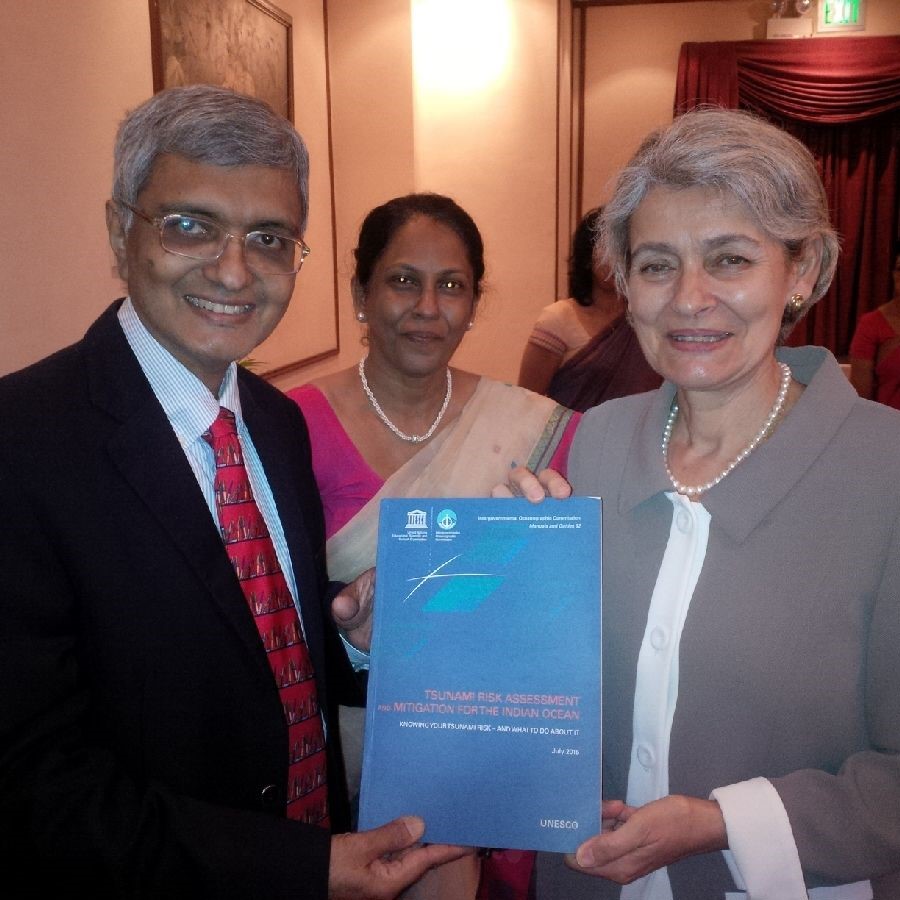 between the Tsunami Unit of UNESCO/IOC in Paris, the ICG/IOTWMS Secretariat in Perth, the Indian Ocean Tsunami Information Centre (IOTIC) in Jakarta, and the Tsunami Service Providers (Australia, India, and Indonesia) in supporting the India Ocean member states. In particular, the successful operation and implementation of all elements of the IOTWMS including training of responders and enhancing preparedness of coastal communities exposed to tsunami threats was highlighted.
Photo: Prof. Hettiarachchi presented a copy of the UNESCO/IOC Guideline on Tsunami Risk Assessment and Mitigation for the India Ocean (No 52 Revised Edition, 2015) to Madame Irina Bokova.
"Pre-IOWave16 Training/Workshop on Tsunami Awareness and Preparedness and Standard Operating Procedures for Tsunami Warning and Emergency Response" in Mozambique and Tanzania
Mozambique and Tanzania hosted training workshops on "Tsunami Awareness and Preparedness and Standard Operating Procedures for Tsunami Warning and Emergency Response", in preparation for Exercise Indian Ocean Wave Exercise 2016 (IOWave16), a regional tsunami simulation exercise set for 7-8 September 2016.
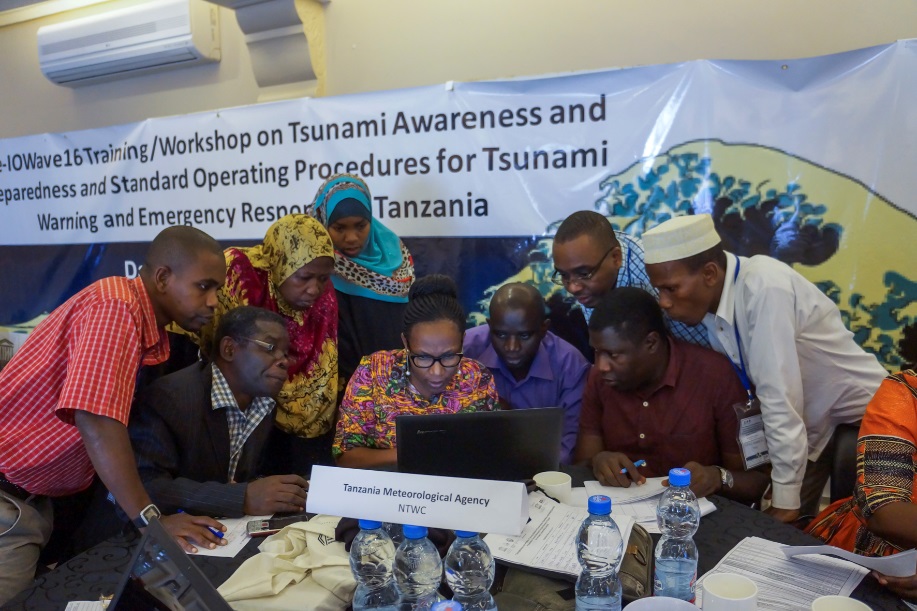
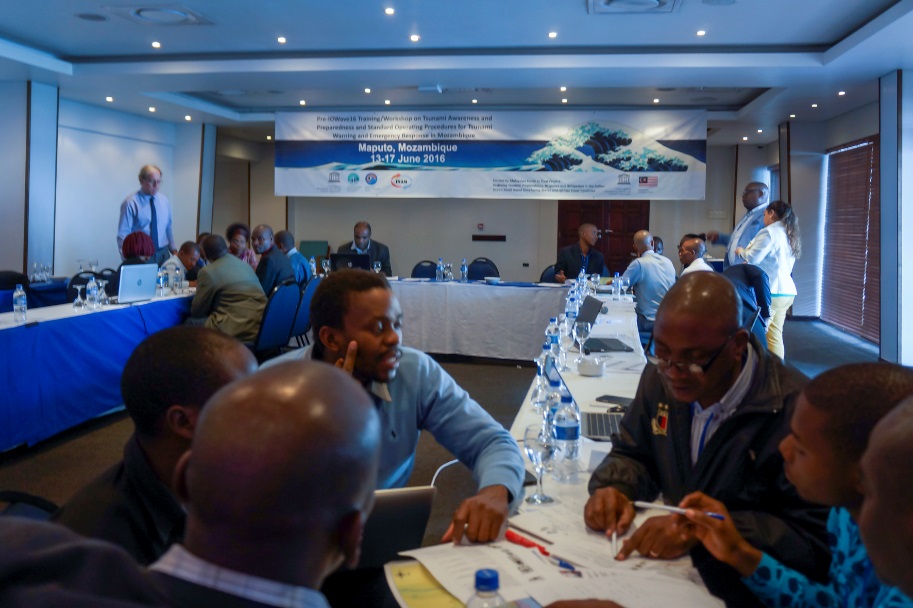
Left: Mozambique participants working in groups discussed the tsunami hazard and risk in Mozambique's coastal areas; Right: Tanzanian participants conducted a table-top exercise to test their standard operating procedures on tsunami early warning (Photos provided by IOTIC)
Based on the Jakarta Office of UNESCO, the Indian Ocean Tsunami Information Centre (IOTIC) of UNESCO’s Intergovernmental Oceanographic Commission (IOC) is implementing the project: “Fostering Tsunami Preparedness, Response and Mitigation in the Indian Ocean Small Island Developing States and Developing Countries” funded by the Malaysian Funds-in-Trust (MFIT). The project aims to strengthen the capacity of Indian Ocean Member States in tsunami preparedness and response and promote full participation and implementation in the tsunami early warning in the Indian Ocean. This MFIT Project focused on two Indian Ocean Small Island Developing States (Mauritius and Seychelles) and two Indian Ocean African Coast Countries (Mozambique and Tanzania).
The training workshops were held in Maputo (13-17 June 2016) and Dar es Salam (20-24 June 2016), and were attended by thirty-six and thirty-three participants, respectively. Participants represented national disaster management offices, disaster response agencies, media and university students. Local organization, logistics and administration were supported by the UNESCO Offices in Maputo and Dar es Salam. The trainings covered topics such as tsunami hazards in the Indian Ocean – with a focus on those affecting the Eastern African Coast –; tsunami preparedness from risk assessment and evacuation planning to awareness and education; tsunami warning standard operating procedures; and focused preparation for September’s IOWave16 tsunami simulation exercise.
The training workshops will ensure that Mozambique and Tanzania institutions have the capacity to actively participate in Exercise IOWave16.
More Articles...
- Pre-IOWave16 Workshop on Standard Operating Procedures for Tsunami Warning and Emergency Response for Indian Ocean Countries
- Technical Visit to CENtre d’Alerte aux Tsunamis (CENALT)
- CARIBE WAVE 2016 Regional Tsunami Exercise
- Municipal committees for the prevention, mitigation and response in the coastal municipalities of San Cristobal, Dominican Republic, received training on tsunamis. December 2015.
About the Tsunami Programme
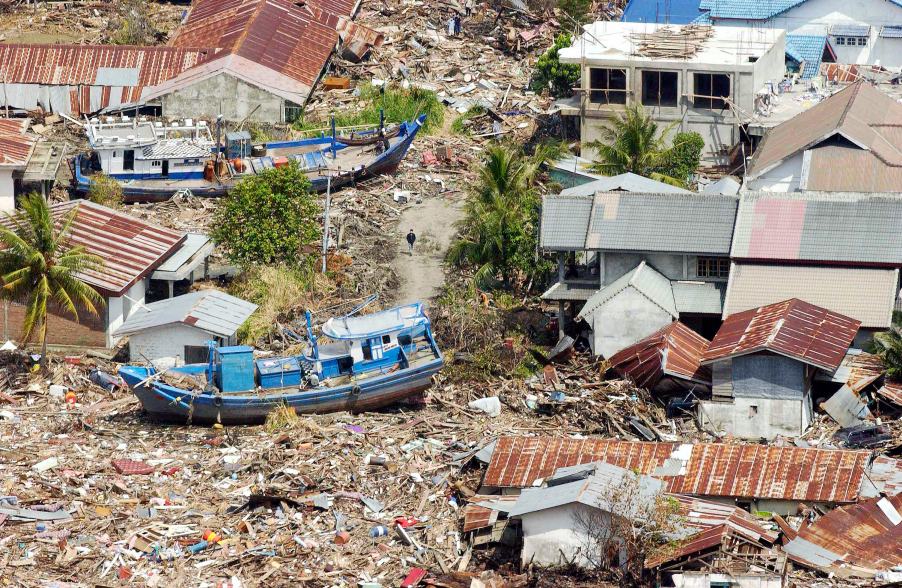
The Indonesian coast, between Banda Aceh and Meulaboh, after the earthquake and the tsunami of 26 December 2004. Photo by Evan Schneider © UN Photo
UNESCO supports Member States in improving capabilities for tsunami risk assessment, implementing early warning systems and enhancing preparedness of communities at risk. UNESCO works closely with national institutions and promotes inter-institutional and regional cooperation. Specialized regional centers provide tsunami information that, together with national analysis, is the basis of the warnings issued for the public. In addition, UNESCO promotes community-based approaches in the development of response plans and awareness campaigns which strongly involve education institutions and end-users.
Upcoming Events
7 August 2024
19 August 2024
19 - 30 August 2024
Chile