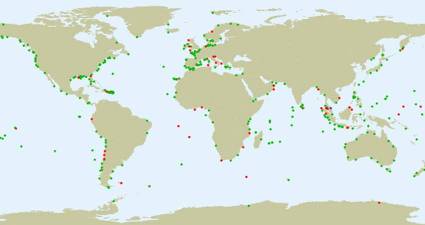
Sea Level Monitoring
TSU/MAB Coastal Hazards Project
Broadcasting Media as part of the Tsunami Warning Chain
In order to strengthen the engagement of media broadcasters in the tsunami early warning processes in the Makran region, a webinar was held on 17th June 2021 as a contribution towards the 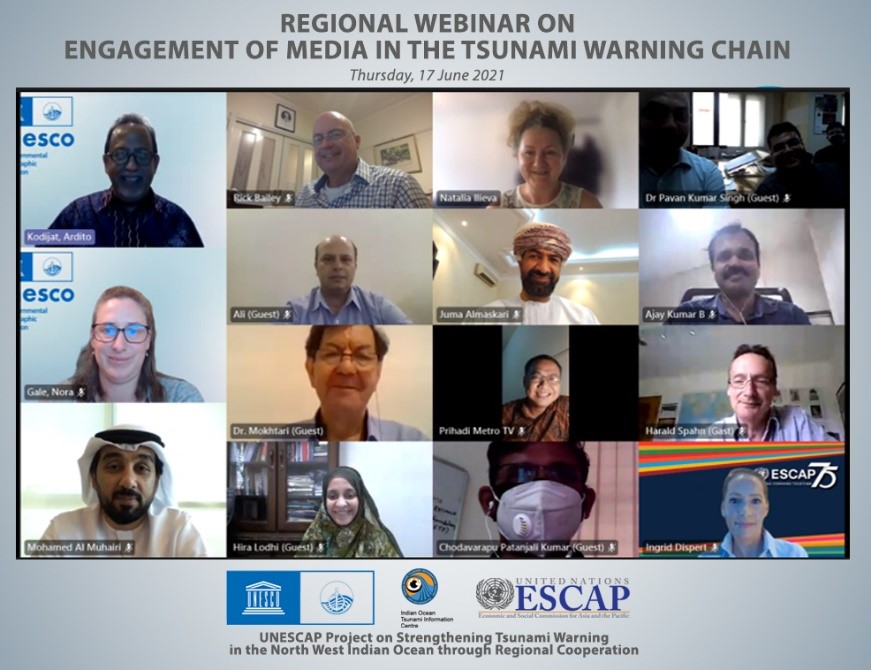 UNESCAP-funded project “Strengthening tsunami early warning in the North West Indian Ocean through regional cooperation” (TTF-29). The event was organized by Indian Ocean Tsunami Information Center (IOTIC), Secretariat of the Intergovernmental Coordination Group for Indian Ocean Tsunami Warning and Mitigation System (ICG/IOTWMS), and TTF-29 Project Team. In total 63 participants attended this event from Australia, Germany, Indonesia, India, Iran, Pakistan, Oman, United Arab Emirates (UAE) as well as the Asia-Pacific Broadcasting Union (ABU), UNESCAP and UNESCO.
Dr. Mohammad Mokhtari, Chair of the Subregional Working Group for the North West Indian Ocean, opened the webinar followed by Ms. Ingrid Dispert representing UNESCAP as the project donor, and Ms. Nora Gale of the ICG/IOTWMS Secretariat. Engagement of the media in the tsunami early warning processes in the Makran region was strengthened through discussion on the role of broadcasting media in the tsunami early warning chain and exchange of practical experiences from the region and beyond.
Session 1 of the webinar introduced tsunami in the Makran Region, the set-up of tsunami early warning in the region, and the role of the broadcasting media in tsunami early warning chain.
Session 2 included sharing media experiences from representatives from Doordashan News in India, News Editor Ministry of Information of Oman, Media and Marketing session of National Centre of Meteorology of UAE, and Metro TV in Indonesia. An Indonesian example on the regulatory framework and implementation as well as the experiences from ABU Media Initiative on early warning and the Emergency Warning Broadcasting System were presented.
Session 3 discussed challenges including the conditions still need to be improved so that the media can play their role in the warning process and issues to be considered when developing tsunami warning standard operating procedures (SOPs) for media. Representatives of the National Tsunami Warning Centre of Oman and Iran, the Disaster Management Organization of India and Pakistan, as well as by the representative of the Media of UAE, Indonesia, and ABU provided statements.
The development of SOPs was recognized as a primary tool to organize the practical collaboration between National Tsunami Warning Centres, Disaster Management Organisations and the broadcasting media in the warning process. Such SOPs need to be developed between the institutions to assure the interconnectivity as well as internally in each participating institution.
This event is a precursor for regional workshops on standard operating procedure development for broadcasting media, which will also involve the national tsunami warning centres and disaster management organisations.
For additional information on the regional webinar on engagement of media in the tsunami warning chain, please refer to the event website here.