Sea Level Monitoring
TSU/MAB Coastal Hazards Project
Lessons Learnt during Exercise Indian Ocean Wave 2023 Webinar
 The UNESCO-IOC Intergovernmental Coordination Group for the Indian Ocean Tsunami Warning and Mitigation System (ICG/IOTWMS) decided to conduct Exercise Indian Ocean Wave 2023 (IOWave23) during October 2023. Different scenarios for tsunami generation were exercised on 4, 11, 18 and 25 October. Recognising that the outcomes from IOWave23 will contribute to a better understanding of the gaps in tsunami warning chains, as well as enhance tsunami preparedness across the Indian Ocean Region, the ICG/IOTWMS Secretariat and Indian Ocean Tsunami Information Centre (IOTIC) jointly organised the “Lessons Learnt during Exercise Indian Ocean Wave 2023” webinar during 12-13 December 2023.
Opening remarks were provided by Professor Dwikorita Karnawati, Chair of the ICG/IOTWMS, and Mr Rick Bailey, Head of the ICG/IOTWMS Secretariat. Ms Weniza, Chair of the ICG/IOTWMS Task Team on Exercise IOWave23, provided an overview of the exercise. Ms Suci Anagrah, Chair of the ICG/IOTWMS Working Group 3 on Tsunami Ready Implementation, spoke about the importance of the UNESCO-IOC Tsunami Ready Recognition Programme. All stressed the importance of developing and maintaining community awareness and preparedness for the tsunami threat. While fortunately tsunamis are relatively rare, exercises are accordingly required to ensure warning systems are fully operational and effective should a tsunami occur.
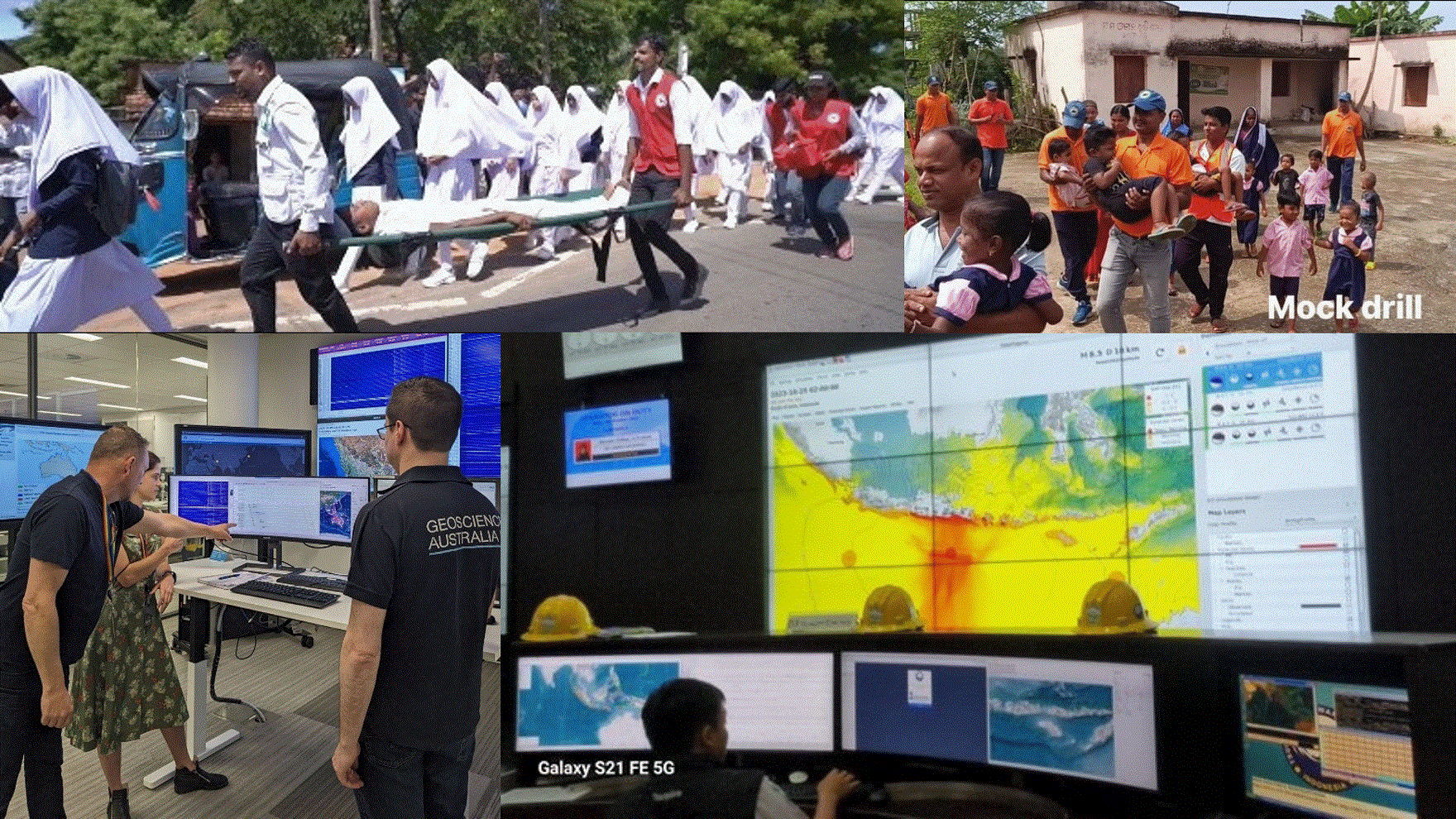
Photo: Participants during Exercise IOWave23 held during 4-25 October 2023.
The webinar focused on Member States’ participation in the exercise, with country presentations from Australia, Bangladesh, India, Indonesia, Iran, Madagascar, Mauritius, Myanmar, Oman, Pakistan, Seychelles, Singapore, Sri Lanka, Tanzania, Thailand, and the United Arab Emirates. Panel discussions were also held on: a) New Tsunami Service Provider (TSP) products for non-seismic generated tsunami, b) Community involvement in IOWave exercises; c) Exercising UNECO-IOC Tsunami Ready indicators; and d) Recommendations for the next IOWave Exercise.
At least 19 Member States participated in IOWave23. While all involved National Tsunami Warning Centres (NTWCs) and Disaster Management Organisations (DMOs), it was encouraging also to see exercising down to community level in 8 Member States, including specific testing of the UNESCO-IOC Tsunami Ready indicators in at least 7 Member States. Around a total of 45,000 people participated in evacuation drills, including all genders, children, elderly, and people with disabilities. Extensive national stakeholder engagement in each Member State, including with media, helped with successful exercise outcomes and greater government and community awareness of the tsunami threat and what to do. As part of the IOTWMS coordinated service, the TSPs in Australia, India, and Indonesia successfully issued test tsunami threat bulletins for each scenario to all Member States. TSP-Australia was commended for their new products for tsunamis generated by non-seismic sources (such as for the scenario of a tsunami generated by a Herard Island volcano), which were tested for the first time.
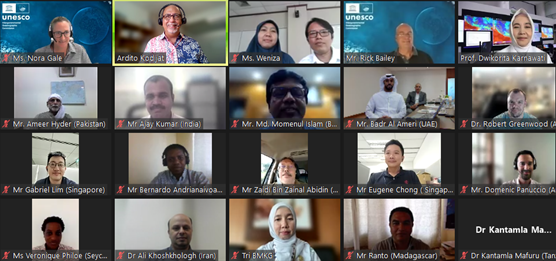
Photo: Participants at the webinar on Lessons Learnt during "Exercise Indian Ocean Wave 2023", 12-13 December 2023.
Recommendations for the upstream components of the tsunami warning system, including the TSPs and NTWCs:
1) Member States should regularly review, update, and test contact information on national warning dissemination lists.
2) National Tsunami Warning Centres should review and update Standard Operating Procedures (SOPs) based on lessons learnt during Exercise IOWave23.
3) All IOTWMS TSPs should develop and implement products for tsunamis generated by non-seismic sources.
4) As well as the workshops organised before the exercise to review and update the national tsunami warning chains and SOPs for each link in those chains for each Member States, further detailed training is required for NTWCs on TSP products, including how to deal with differences in predicted wave heights and how to best utilise the new non-seismic generated tsunami products.
Recommendations for the downstream tsunami warning system, including DMOs, communities, and media:
1) Further implementation of UNESCO-IOC Tsunami Ready Recognition Programme, or similar national initiatives, supported by appropriate resources is urgently required to ensure communities receive warnings and know what to do to meet the goal of UN Ocean Decade Tsunami Programme of 100% at-risk communities prepared and resilient to tsunami threat by 2030, plus UN goal of "Early Warnings for All" by 2027.
2) Community tsunami awareness and preparedness activities should be regularly conducted and accommodate all in the community, including all genders, all ages, and those with disabilities.
3) Ensure communication between stakeholders in the national tsunami warning chains is effective.
4) DMOs, communities, and media should review and update SOPs based on lessons learnt during Exercise IOWave23.
In terms of exercise planning, it was recommended to conduct future biennial IOWave exercises at alternative times of the year to allow the full participation of Member States that are occupied with other hazards during the September and October period. Member States were encouraged to undertake national exercises and drills in the alternate years, so that exercises of some form are at least undertaken annually.
Work to finalise a full and extensive exercise report will be undertaken by the Task Team on Exercise IOWave23. This report and further information on IOWave23 will be made available on the IOWave23 portal (www.iowave.org).